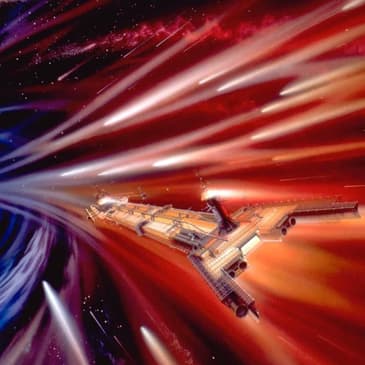
Dan and Conrad venture into Disney's 'dark era' again – this time with a sci-fi twist! It's The Black Hole (1979), the mouse house's answer to the colossal box-office and cultural phenomenon of Star Wars two years prior. And like all dark era flops, it uncomfortably straddles mature themes (an egomaniacal scientist determined to journey through a massive black hole and willing to enslave his entire crew as zombified androids to do his bidding) with family-friendly fun (robots with Disney eyes having laser battles). The result is a grandiose, steampunk adventure with stilted dialogue, eye-popping visuals and a doom-laden score by John Barry at his finest... but is it any good? Or are Conrad's nostalgia goggles deceiving him? Find out!
Follow us on Tiktok, Facebook, Instagram and maybe what's left of Twitter, if it's still functioning.
Support us on Patreon to nominate future films, vote on whether films should be released or thrown back, and access exclusive bonus content!
Support us on Patreon to nominate films for us to cover, access exclusive bonus content, and vote on the final verdict!
Rate and review us on your podcast platform of choice, and tell a friend about us.
Follow us on TikTok, YouTube, Instagram and Bluesky.
Hosted on Acast. See acast.com/privacy for more information.
[00:00:12] Welcome to Movie Oubliette, the film review podcast for movies that most people have mercifully forgotten. I'm Dan. And I'm Conrad and in each episode we drag a forsaken film out of the Oubliette. Discuss it and judge it to decide whether it should be set free.
[00:00:30] Or whether it should be thrown back and consigned to oblivion forever. Come with us and no, no, not the Movie Oubliette. Childhood nostalgia. Welcome to episode 152 of Movie Oubliette, the trans-hemispherical podcast for forgotten fantastical films with me, Conrad, launching a new YouTube channel in Cambridge, UK.
[00:01:11] I can't wait. And me, Dan, enjoying a three day weekend down here in Melbourne, Australia. We focus on forgotten fantasy sci-fi and horror films because we love mind bending metaphysical journeys into the unknown, laser battles between robots with Disney eyes and Norman
[00:01:29] Bates having a stomach churning death. Hello, Dan. Wow, that's a lot. Hello, Conrad. Isn't it just? So you got a three day weekend. Yes, yes. Monday is King's birthday here in Australia. It used to be called Queen's birthday for my entire life.
[00:01:51] So it's quite strange to say King's birthday these days. But I hear that the UK does not celebrate King Charles' birthday like we do. No, no, we've got the damn King and we don't get a day off. That's not fair, is it?
[00:02:07] I mean, what's also interesting is it's not actually his birthday. So I looked it up. His birthday is on November 14th. So very far away from his actual birthday. So I don't know who chooses the day that we celebrate his birthday.
[00:02:24] But this Monday in Australia is the day. Oh, it's his official birthday. That's nice. In Australia. In Australia. But not New Zealand or the UK. I think it's different New Zealand. And I'm guessing other Commonwealth countries have different King's birthdays. I'm not sure. I don't know. That's ridiculous.
[00:02:48] Meanwhile, Conrad, new YouTube channel? Yeah, Joe Lipset of The Horror Queers and I have teamed up to make a new YouTube channel called The Queer Gays. And that's G-A-Z-E. And it's one of those reaction YouTube channels where basically you've got the two of us
[00:03:10] watching a movie and reacting to it. And we are watching queer coming of age movies from throughout history all over the world. Kicking off with something from the 70s in Denmark, I think. Okay. Yeah. Wow. Yeah. Interestingly, the first film that we watched does depict a relationship between
[00:03:32] very young protagonists. And at one point there is a scene that shocks both of us. And poor Isaac, a friend of the pod who looks after all of our socials, Isaac was editing these episodes for us and he had to blur out large portions of it
[00:03:54] to be permissible on YouTube because, oh my. So look out for Isaac's sense of humor with the editor's comments that sort of pop up on the screen. It's very funny. Anyway, the first episode drops on June 10th. It's all for Pride Month, of course.
[00:04:11] So yeah, head on over to The Queer Gays if you want to follow our journey through gay movie history. Yes. Yes, yes, yes. I can't wait. Yes. And I should say there's some fantastic music on it too. Oh yes. Yeah, I had a hand in that.
[00:04:28] Yes, you did. Yes, you could post all the music influenced by a popular queer TV show that I forced you to be influenced by. So that was fun. I mean, it's funny because I listened to the Heartstopper soundtrack so much
[00:04:45] that it was my number one album that I listened to on Spotify last year. Was that research for The Queer Gays channel or just you loved listening to it? I mean, I did love listening to it as well.
[00:05:01] I was listening to it a lot regardless, but yes, a lot of referencing and just getting the sonic palette of what you were after. Yeah, you totally nailed it. It's a really catchy tune. Enjoy that, everyone. Okay, mailbag time. What have our listeners been saying?
[00:05:23] Well, Chazilla got in touch about Dog Soldiers and he said, If you liked Predator, Alien 1 and 2, Jurassic Park and every Werewolf movie ever made, then you should really like Dog Soldiers. It's either the biggest homage to them or a ripoff Corman style.
[00:05:40] It has elements of each story and most of the shots were blocked so closely to them, I wonder about copyright infringement. How about that shot when the guy bought it in the Jeep? It started off Aliens and finished Dennis Nedry style. Good job. Two ripoffs in one scene.
[00:06:00] Yeah, I do remember Neil Marshall saying there were a lot of references in that movie. To other movies. Yeah, it's a bit of a love letter to a lot of movies. Chazilla also said, I spent most of the film wondering where the silver dagger went.
[00:06:17] I was relieved when it magically showed up in the last four minutes for the final kill. How did a pack of werewolves get a silver dagger back to the house? Yeah, I mean, I think the explanation was they were killing these victims, hikers, campers,
[00:06:36] and then bringing them back to the house and storing them. And I guess one of the victims had that silver dagger on his person as they were transporting it back to the cold storage underneath the house. Yeah, the larder.
[00:06:53] It was a very far-fetched sort of connection to an item that you saw in the first five minutes of the film. I mean, I was a bit confused. I was too. Also, very odd choice of gift for a girlfriend to give to her boyfriend. Yeah, a bit strange.
[00:07:13] Whilst camping in the woods. Here's a silver letter opener. Congratulations on your... Is it for his promotion or something? I don't know. It's very odd. And it's sterling silver she had to add as well, you know? Of course.
[00:07:28] It's the purest silver that would be not helpful for anything, not anything else, but letter opening. Yeah, apparently. Who knows? Very strange, but yeah. Well spotted, Chazelle. Thanks for writing in. And of course we heard from Serge of Cold Crash Pictures. Hello, Serge. Oh, hello, Serge.
[00:07:52] And he said, dog soldiers wears its influences on its sleeves. But as someone who doesn't really spark to many werewolf films, I thought this one was good, gory fun. Not so much about curses and our beastly nature, as much as 105 minutes of competent siege-based horror. I would agree.
[00:08:11] Yes, yes, yes. Yeah, basically that's the podcast summed up in two sentences. If you ever want to skip the podcast, just follow Serge on Twitter. Yes, yes. Anyway, thanks everyone for getting in touch as always. We love hearing from you. Yes we do.
[00:08:33] Okay, onto the episode for today. What is the movie Conrad? Well, let me just hover over to the Oubliate and find out. Whoa, I appear to be in a very, very long sci-fi tunnel. Oh, watch out. There's robots firing lasers everywhere. What's that in the distance?
[00:08:56] Out the window? I don't know. It looks like a blue doughnut in space. Oh, I think I found a DVD here. Hang on, coming back. Okay, okay. Well, activating the microbeam. So a bit of a special one today. What do we have?
[00:09:13] Yes, this one is a little bit of childhood nostalgia. It's the 1979 American science fiction film The Black Hole, directed by Gary Nelson with a screenplay by Jerry Day and Jeb Rosebrooke, starring Maximilian Schell, Robert Forster, Joseph Bottoms, Yvette Mimeur,
[00:09:41] Anthony Perkins, Erganis Borgnein, with uncredited voiceovers of Roddy McDowell and Slim Pickens. Ah yes, and this movie was also voted by our patrons. There was a big pool of all the submitted patron choice movies and yeah,
[00:10:01] put them all to a vote and this one came out on top. Yeah, this is the one that they wanted to see the most collectively. So interesting choice. Yes, so what happens in The Black Hole?
[00:10:13] Well at some point in the 70s future we join the intrepid crew of the USS Palomino, the stoic Captain Dan, the young loose cannon Charlie, scientists Alex and Kate, who has an ESP Bluetooth connection with the ship's philosophy spewing robot Vincent,
[00:10:33] and essential crewmate for the post-Watergate era, a schlubby journalist called Harry. They discover what appears to be a derelict spacecraft teetering on the edge of a gargantuan black hole. The USS Cygnus lost many years before along with its crew,
[00:10:52] including Kate's father, but it isn't so derelict after all. In fact, it's filled with a robot crew, a robot army and a menacing robot henchman called Maximilian, all carrying out the orders of a megalomaniac Dr Hellbent on a history-making journey in,
[00:11:10] through and beyond, a rip in the very fabric of space and time. But what really happened to Dr Reinhardt's crew? Why do some of his robots limp and stage elaborate space funerals? Could the genius actually be a sociopathic narcissist
[00:11:28] with a God complex who threatens to kill everyone in his quest for glory? And what happens at the end of this damn movie? Find out after the break. And we're back to talk about Disney's dark period sci-fi movie, The Black Hole, voted for by our
[00:12:00] patrons and childhood nostalgia for me personally. Had you seen this one Dan? Ah, so I thought I had seen this movie. I swear I had, but I did not recall a single moment in this movie. So it was... One of those.
[00:12:17] Yeah, it feels like a complete fresh viewing for me. It was, yeah, quite a surprise. I did not expect this. This is again from the dark period of Disney where they were trying to do more adult content, darker themes, interesting concepts with science fiction in this movie.
[00:12:42] So I believe you watched this a lot as a child. Yeah, I love this one. So I probably saw it on television, first of all, Pan and Scan, which with a very wide screen movie was quite irritating because the camera would be sliding all over the place.
[00:12:58] Oh, really? Ah, right. Yes. Yeah. And sometimes they would focus on the middle of the screen and you could just see the tips of two people's noses. So it was not the ideal viewing experience.
[00:13:09] It sounds like TikTok at the moment, where they try to squeeze wide screen into this mobile phone. Portraitical. Yeah. And it's just awful. Absolutely hate it, yes. But I watched it on TV a lot, recorded it and watched it
[00:13:26] very much like Star Wars. And it was another one of the ones that Anchor Bay released on DVD around the same time as Watcher in the Woods, because Disney was ashamed of this movie.
[00:13:40] So it was one that they did not release on physical media for a very long time. Now it's on Disney+. They have re-owned it. It's there now. Because I mean, I did want to ask, this movie came out in 1979. Was it a response to Star Wars?
[00:13:57] Very much so. Although oddly enough, it didn't start that way. It started as a response to the wave of disaster movies that was happening in the 70s. So things like the Poseidon adventure specifically, which is interesting with Roddy McDowell and Ernest Borgnein in
[00:14:15] the cast of this movie. It has very much that all star cast of survivors trying to survive a series of disastrous events, but in a space setting, which they thought would be interesting. And then Star Wars comes out in 1977. And this thing that had been languishing in
[00:14:35] development hell since 1974 gets revived and focused more on robots shooting lasers at each other for kids and older kids. Yeah, because it did feel more mature. Like it's not a kid's movie, but again, the violence is definitely toned down. Like Anthony Perkins character, Alex Durand, he gets
[00:15:00] blended by Maximilian. Spoilers here. And you see no blood whatsoever. He just falls off the edge. But yes, there seems to be a lot of Star Wars influence, just the laser blasting guns that they use. The sentry robots and the drones just feel very Star Wars. There's
[00:15:21] one sentry robot, STAR I think they refer to. It just looks like a really slim Darth Vader. Yes. It's like Darth Vader just kept a little bit more fit. Yes, he's the prototype. He was the head honcho of all of the robots until Maximilian came along.
[00:15:42] But I mean, the sort of setup of this movie where you have this crew, are they like a research crew? They just stumble upon the space station on the event horizon of the black hole,
[00:15:55] and it's just there. That feels to me very like Star Trek. A group of scientists or engineers discovering things and finding an abandoned spaceship and investigating, figuring out what happened. Like it has that sort of sense of intrigue and mystery that Star Trek has.
[00:16:15] It does. Yeah. So their mission, as Kate McCray, the scientist says at the beginning, is to discover habitable life in outer space, which doesn't make any sense. Actually, habitable life. Life that you can live in? What does that mean? Oh, well, I don't know. Semantics.
[00:16:36] Yeah. But yeah, basically, they're boldly going to seek out new life and new civilizations is essentially what they're doing. So yeah, it is very Star Trek. And of course, they've got an anomaly in space, which is always one of my favorite things in Star Trek episodes.
[00:16:50] I loved a space anomaly. And they've got a derelict spacecraft that's just hanging there in darkness. So yeah, it's got a lot of mystery and it's also got a whole cast of adults who are very serious people for the most part. I think the audience identification
[00:17:07] figure is supposed to be Charlie Pizer, the sort of youthful, adventurous guy that always wants to do the risky thing. Whereas Dan played by Robert Forster is the more seasoned captain who's very
[00:17:20] stoic and wise. Yeah. Yeah. I quite like the sort of collection of characters. I didn't find them too cliche. I guess they were a little cliche, but they weren't annoying. There weren't intolerable characters. There wasn't the asshole or the misogynist, you know, they were all very
[00:17:40] respectful of each other and they all had their role to play. And then when they come across Hans Reinhardt, who was this, he kind of comes across as like sort of like a communist dictator
[00:17:53] of the spacecraft where you've got all these robot drones under his command and also Maximilian being his sort of personal guard. And yeah, it's just sort of the dynamic between the characters from the research discovery ship and this guy that really thinks he's
[00:18:15] pretty much God trying to figure out how to go through a black hole on his sort of anti-gravity spacecraft that he's managed to develop. The characters are all broad brushstrokes. I mean, they've pretty much only got one thing about them and that's their thing.
[00:18:34] Anthony Perkins' character, Alex Durand is the starry-eyed scientist that just worships Hans Reinhardt and is almost instantly apologizing for anything that he does that seems suspicious and ominous and obviously evil. Well, you know, maybe his communication
[00:18:54] system wasn't working and that's why he didn't talk to us when we first found him. And he's apologizing all the time right up until the point where Maximilian churns his guts out. The captain is just sort of the stoic anchor for the whole thing. Admirable, sensible leader.
[00:19:10] You've got Charlie Pizer who's the hothead that you're supposed to love. Yvette Mimeur as Kate McCray. She pretty much only has one thing to do, which is like sense things because of her ESP ability. That was the part of this film I did feel
[00:19:26] odd because it was very ruched in science and quantum concepts and science-based ideas. And then she's got ESP for some reason. And the only person or thing that she can communicate with is a robot. So she has ESP with a robot, Vincent. So it's quite strange.
[00:19:48] I don't know how they thought that was a good idea to insert in a very science-based science fiction movie. Yeah, it feels like it's been pulled out of the writer's ass at the last moment to explain how she can communicate with Vincent for key plot point developments.
[00:20:05] In the novelization by Alan Dean Foster, he claims that it's because she has some sort of technological implant. So it genuinely is a Bluetooth connection that she has with robots. Yeah, that would have made more sense. So it is still rooted in technology rather than
[00:20:23] supernatural ability, which is good. I mean, all she had to do was have some sort of thing on her head that she touches or beeps. That would have made more sense than I have ESP,
[00:20:36] yes, somehow with a robot. I know it's an interesting quirk. Certainly one of the things that I always remembered about the movie is it has this interesting conceptual quirk that blends the supernatural with the scientific. Right. Yeah. Her character isn't
[00:20:51] given much to do apart from hope that her dad's there get disappointed when she finds out that she isn't and then just be very empathetic and a damsel at one point. Yeah. So it's, you know, not great for the Kate character.
[00:21:05] Yeah. I mean, I don't think it was bad though. No, I think it could have been much worse. You know, like it could have been exploitative. But I mean, they wouldn't do that in the Disney movie. Of course not. But,
[00:21:17] you know, it could have been much worse. Yes. On top of these characters, you have also the robot characters. So you've got Vincent there for philosophical spouting. To me, he looks like one of those, you know, those vacuum cleaners
[00:21:37] faces on them. Henry. Yeah. Yeah. He looks a lot like one of those except, you know, without the pipe and hovering. Yes. And yeah, it's interesting because the first I looked at the first Henry vacuum cleaner with the face on it made by pneumatic international
[00:21:55] came out in 1981. Really? Maybe they were influenced by Vincent. Quite possibly. It would not surprise me. I've never made the connection before, but now you say it. Yeah, it's uncanny. Yeah. But yeah. So you've got Vincent as their
[00:22:11] philosophical robot and you've got another older version of Vincent that they come across called Bob who is, looks barely functioning. I mean, he's just bits of scrap somehow joined together and he's voiced by some Pickens who I didn't know who some Pickens was. I looked
[00:22:29] up his IMDB and it says some Pickens spent the early part of his career as a real cowboy and the latter part playing cowboys. Yes. He's always like playing these cowboys and he is
[00:22:42] pretty much sort of a down on his luck cowboy robot in this movie. And of course, yeah, Roddy McDowell voices Vincent. Why was he not credited? I have no idea. Because I feel like he's, he's a very
[00:22:57] major character. Yeah. And this is our third movie this year that we've covered with Roddy McDowell. Really? After Legend of Hau House and Shakma. But yeah, his voice is quite iconic and yeah, he is a great character despite the kind of shoddy robot design and obvious strings everywhere.
[00:23:23] Yeah, I know. They try to hide them. They do try to hide them. They played all kinds of tricks like rotating the set and rotating the camera so the strings are going downwards rather than
[00:23:34] upwards so that you look in the wrong place for them and you miss them. Sometimes he's just like on a trolley bobbing up and down and somebody's moving him along in front of the camera because you can't see the bottom. But yeah, there's a lot of strings, unfortunately,
[00:23:48] in the HD print of it that's on streaming services now. Yeah, yeah. But I did notice like they do portray gravity fairly well. So the other characters are also obviously on strings as well, but you don't see them as much.
[00:24:04] No, they did that quite well actually. It was quite gruelling. I think Robert Foster, Yvette Mimeo and Joseph Bottoms had to spend a couple of weeks in circus training learning how to control their core and balance whilst on these strings. Yeah,
[00:24:19] it was quite an endurance test for them. Yeah, I thought they pulled it off quite well, a lot better than Space Camp, I thought. Oh gosh, yeah. Yeah, there's a callback. Yeah, but I mean, as soon as they get to the USS Cygnus, of course,
[00:24:35] somebody just says, oh, we have gravity. And there you go. That's the end of it. They never mention it again. They're all running around. Yeah, they are. I know. Gravity just exists on, I mean, he does have that reactor that
[00:24:46] supposedly has anti-gravity or that's why it's where it is and not sucked into the black hole. Of course. And our third major robot character is of course, Maximilian, who was a nonverbal robot. He does hum a little bit
[00:25:02] and, you know, has red eyes because he's evil. Of course. Yeah, because all red-eyed robots are evil. That's just the standard. But he is kind of a character. Like he has this kind of stubbornness about him. And also like loyalty to Reinhardt,
[00:25:19] but also he feels like a slave to him. So he kind of betrays him at the end. He does. Yeah, he lets him die, which is really interesting. So you get the sense that Reinhardt doesn't have complete control over Maximilian. And there's even a wonderful moment
[00:25:35] in the film that I really love where after Maximilian has murdered Alex Durant, the Anthony Perkins character, Reinhardt steps aside with Kate and says, protect me from Maximilian. And I have no idea whether he is telling the truth, that Maximilian is actually
[00:25:56] the one pulling the strings here, or at least that he feels threatened by him, or whether he's lying and manipulating her, or if he's insane. Apparently it was an improvised line by the great actor, Maximilian Shell on the set. And the director, Gary Nelson,
[00:26:11] loved it. He thought it was great. Okay. I thought that was ironic as well, that the actor's name was Maximilian and he kept calling out, Maximilian. Yeah. He is named in his honour because they were really thrilled to get Maximilian Shell,
[00:26:26] the great Oscar-winning actor from Judgment at Nuremberg, to appear in the movie. Because you needed somebody with the gravitas to pull that role off. And he definitely has it. He comes across as incredibly intelligent, completely aloof and insane as well, which is
[00:26:46] exactly what you need. He's one of those delicious villains, a character that's evil but really intriguing. He is intriguing and it's fun watching it as an adult again. I haven't watched it in many, many years. Although the writing isn't always
[00:27:01] great, they do hint at his narcissism or his sociopathy because when Kate asks him about her father and he says that, sorry to dash your hopes but he's dead. He talks about Frank McCrae
[00:27:18] only in terms of what he does for him. He calls him loyal. He says that he was a terrible loss to me, such a loyal crew member. He only talks about another human being in terms of how
[00:27:32] they serve him. It doesn't actually acknowledge that he was a sentient being of his own. So the hints are all throughout the writing that this is not really a great person to be around and
[00:27:44] certainly not trustworthy. Yes, I did find there were a lot of concepts and themes in this movie that were quite complex. It wasn't what I expected in a Disney film. So yes, you have this character that has his God complex but he's also a scientist. He's pursuing
[00:28:04] a scientific discovery of possibly going through a black hole and seeing what happens over a whole bunch of humans being alive. Still unsure of how he single-handedly overpowered the entire crew of his spacecraft. Going into spoilers here, big reveal. All the
[00:28:24] robot drones were the crew of Cygnus and so he somehow converted them into humanoid zombie robots. He has, yeah. You get to see his zombification hospital where people sit in tinfoil hats and get lasered in some way and it destroys their minds or at least their
[00:28:44] individuality or free will. Then he pops them in like a combination of a monk's robe and a fencing mask and then just sends them out to carry on their work forever. Yeah, it's a chilling concept that it's really quite disturbing. It's not explored in any great detail.
[00:29:02] Yeah and even the reveal is quite disturbing. I think Alex takes off one of the masks and it's just like this chrome reflective mask. Like you can't see any features and then it's just like a husk of a human on the inside gasping and it's horrifying.
[00:29:22] It's really horrifying. So yeah, you've got this idea of morality versus scientific achievement and also the idea as well that robots have humanity as well because you have Vincent who is a very loyal and respected part of the crew. Like they save him, he is one of them
[00:29:45] and that scene where Bob dies, it's really heartfelt. So you have this idea that the robots are just like humans too. Like they don't treat them worse than any of the other crew
[00:29:57] members. No, they don't treat them as tools. He's very much a part of the crew so much so Charlie Pizer even wants to risk his own life to save him at the beginning of the movie
[00:30:06] when the Palomino tumbles out of control as it gets beyond the sickness's gravitational field and starts getting pulled towards the black hole. And yeah, the death of Slim Pickens' Bob is really touching. There's a reason for that and we'll probably get to that
[00:30:23] towards the end of the main discussion which is the music. That was one of the scenes on the pan and scan version that was pointless because they fixed the camera, the pan and scanned bit on the centre of the frame and you could see neither of the robots.
[00:30:36] So you're just looking at a wall. What? Oh my god. Yeah. And just like voice over. Yeah, voice over and a wall that was wobbling slightly. Honestly, pan and scan was hell. Wow. I don't think I ever got to experience that.
[00:30:55] No, you're very lucky. Pan and scan on a 4-3 TV just destroyed directors' movies completely. Oh god. It's terrible. There seems to be a theme of science versus religion or like faith because they,
[00:31:17] I mean big spoilers here, they go through the black hole and Reinhardt and Max Millian merge into some Rhyne Max conglomerate where he's in the robot suit and then he appears to be atop this cliff in hell. It's like fire and brimstone everywhere and then all the drone
[00:31:40] robots sort of underneath is his kind of acolytes. So that's hell whereas the other characters, they fly through the black hole but as they emerge through the black hole, it's a crystal corridor and they're led through by this kind of angelic floating figure.
[00:31:57] Yes. So yeah, human and hell I guess? The ending is much debated. It's a curious thing. So all the way through shooting, they had no idea what the ending was going to be. They could not figure out what they were
[00:32:11] going to see or experience when they went through the black hole. Their original idea was still very religious in its overtones. They were going to do that spinning camera shot into Kate's eye and then they were going to pull out from the eye of Adam on
[00:32:29] Michelangelo's painting of the creation of Adam on the Sistine Chapel ceiling. And they got special permission to film there by the Vatican and they did go out and shoot that ending. So the camera pulls back from the creation and pulled back to reveal Kate
[00:32:48] standing there looking up at it, roll credits. I mean, at one point, Alex Geron does refer to it as a journey into the mind of God. So there is this sense that at the edge of physics lies
[00:33:00] something that touches on the divine that they will experience and then they ended up with this less spiritual but confusing ending and went for one that's a very literal journey to heaven and hell for goodies versus baddies. And that Reinhardt shot where he's encased in his
[00:33:19] own robot, I thought that was him being punished for what he did to his crew, that he gets encased in one of his own creations. Yeah. Yeah. But is this a metaphor for like the
[00:33:28] afterlife? Is this like going through the black hole? Is this like life and death? Is that what it's about? Quite possibly. It did kind of remind me quite a bit of 2001 Space Odyssey, the end of that where he saw his deathbed and then he's reborn again. And it's
[00:33:44] just like, is this like being reborn going through a wormhole, black hole into another reality? Like what is this? There is this sense, you know, almost like the sea is a metaphor for
[00:33:58] you know, the eternity that space is the science fiction sea. And that if you go to the farthest reaches of it, you will have this sort of experience of either existential dread or divine rebirth. I don't know. It seems to inspire things on that sort of scale in
[00:34:16] terms of stakes. Yeah. Well, I mean, in terms of a Disney film, I was not expecting that. No, which is why they ditched the Michelangelo painting ending because they thought this is just too explicitly religious. So we'll go with the heaven and hell imagery and hope that
[00:34:34] it's metaphorical enough to get away with it. I know it's still very religious. Yeah, I didn't mind it. It was quite not abstract, but it was not sciencey is what I'm trying to say. It was quite the opposite. Yeah, it's interesting that Christopher Nolan's movie
[00:34:53] Interstellar from was it 2014, which ends with a character going into a black hole. He also ends up in a sort of quasi rebirth experience where he gets to interact with his daughter throughout her life. And it's sort of like the library. Yeah, like the afterlife.
[00:35:11] He seems to be apart from time and able to exist spiritually for his daughter. She describes him as a ghost. So it touches on the same sort of landscape. Interestingly, because Interstellar touched on similar themes, Joseph Kaczynski, who directed the belated sequel to Tron in 2010,
[00:35:33] he was planning to do a black hole remake for Disney with a much darker, more technological script by John Spates, who co wrote the Dune adaptations recently with Denny Villeneuve. But the thing was shelved when Interstellar came out because there were just too many
[00:35:52] similarities. Right. Yeah, I mean, I wrote three movies down that I thought did the black hole influence and one of them is Interstellar. Yes. Another one is Event Horizon. I mean, they're in the same place essentially by a black hole. And then Sunshine was another one
[00:36:11] that came to mind where they do come across a seemingly abandoned spacecraft with a crazy person on board. Yeah, that's true. Kind of similar in sort of premise. And it's catnip for me. This is why it always stuck with me because I do love exploring a derelict spacecraft
[00:36:32] for some reason. It just pushes buttons in me. There's something about it that I find really compelling. Yes. One thing that did struck me about this movie was it is kind of on the cusp. So older science fiction movies had this kind of real silly campy-ness to it,
[00:36:49] similar to Battle Beyond the Stars, which is actually a newer movie. But it had that kind of science fantasy where it's just like a whole bunch of costumes and laser guns and stuff like that. Whereas more modern science fiction movies were kind of more high concept,
[00:37:05] interesting quantum physics and time travel and sort of more complicated in terms of like concepts and plots. And this movie kind of has a bit of both. Like it is quite silly looking. Yeah. The sentry robots, they look great but they walk around like they look very silly.
[00:37:23] And a lot of the action sequences in this movie felt silly and clumsy. Really? I quite like them. I particularly like the fact that the robots once they're shot, they are effectively replaced by mannequins. They just blow up.
[00:37:39] Yeah, and then they fall to pieces. Especially that shootout in that long corridor where they just essentially go limp and fall off the gantry way and smash into pieces. I quite liked that. It's something I hadn't seen before. The storm troopers don't do that
[00:37:54] because they're humans. Yeah. I didn't mind that sort of third act of action, but I don't know. Some of the previous action didn't quite have the same tension building and energy as
[00:38:08] some of Star Wars action sequences. I don't know. It had an element of this is old science fiction. This is what science fiction used to look like and it shouldn't really look... I mean, it is still the 70s though. So it's kind of still developing into the 80s.
[00:38:26] Now you're right. And the interesting thing about this is it kind of falls between two stools. You've got the sort of space fantasy space opera of Star Wars and then you've got the hard science fiction of something like Interstellar or 2001 in fact. You've got this
[00:38:41] megalomaniac scientist on the cusp of a scientific discovery going through the black hole and that's all very, very serious and dour and it's sort of overlaid with this sense of dread and ominous power of this thing. And on the other hand, you've got robots with
[00:38:58] Disney eyes firing lasers at each other. So it sort of falls between these two stools quite awkwardly I think and that's one of the reasons why I don't think it was a huge success. It yielded 35.8, so nearly 36 million on a 20 million budget when it was released just before
[00:39:17] Christmas in 1979. It was released a few weeks after Star Trek The Motion Picture which did much better in the box office. So the big hitters in 1979, number one Superman, which was released a year ago at that point, the Amityville horror, Rocky II,
[00:39:37] Star Trek The Motion Picture which comes in at number four for the whole year even though it was only released in December and Alien. It was a heady time for sci-fi and I think
[00:39:48] the black hole kind of fell into a black hole because as we've said, it falls between two stools. It's sort of pointing towards something really quite sinister and dark and serious and frightening. Also, it's still Disney. So it's sort of got the cutesy stuff in there so it
[00:40:05] doesn't fully commit to it. So as a kid I always found that intriguing because it was pointing towards a love of horror that I would develop later in life. Sure, sure, sure. Yeah, exactly. Yeah. Like if they leaned into the more gruesome,
[00:40:20] it could have been a really dark science fiction movie. Like really dark. Oh yeah. If they showed blood and yeah even the showdown between Vincent and Maximilian was pretty brutal because at one point he extends this spinning, I don't know, extension that
[00:40:41] drills a hole in Maximilian. It's like the closest they could get to actual brutality or like you know violence but they're robots so of course no one cares. No, they're crashing into each other and electrocuting each other and then drilling
[00:40:57] into each other which is kind of poetic justice for him after what he did to Alex Durant. Yeah I always find it funny how this happens a lot in Disney or just cartoons is if you
[00:41:09] want to have violence just make it a robot. You can slice and dice them, you can like stab them but they're robots so it's not real violence because there's no blood and they just go all electric and they're robots. Yeah it's fine.
[00:41:24] Yeah it's like the Jedi's in the Phantom Menace slicing up all of those droids that's all fine yeah. Yeah exactly like no one gives a crap about robots they're not humans. No. You can just like slice the shit out of them and it's fine.
[00:41:39] Now it's time for Random Trivia. Okay Conrad what piece of trivia did you find almost getting sucked into a black hole today? Well one little fun piece of trivia. The director Gary Nelson has a cameo in the movie, can you guess where he is? Is he the drone?
[00:41:59] The one where they take the mask off and he looks awful? Yeah. That's the director. Oh wow oh wow yeah that's great. Yeah I don't know whether it's a commentary on how much the
[00:42:15] production was weighing down on him that he was just a husk of a man by the end of it. Yeah it's the director underneath that mask. Ah that's incredible. Yeah and that's our trivia. Yes. Let's get into it. John Barry.
[00:42:36] John Barry who had never scored a science fiction film at this point in his career. Ah right. Not a good one anyway. In 1978 he did score the low budget Star Wars ripoff Star Crash but
[00:42:48] this is his first major production. 1979 also saw him doing the James Bond entry Moonraker which was also heavily influenced by Star Wars and climaxes in a laser battle in space. He'd never done anything like this before and I think what's fascinating about it
[00:43:06] is how different it is from Star Wars. Yeah yeah it's very triumphant, it's very it does remind me of the score from the Battle Beyond the Stars which is worse, it's much worse. You know you've got wrong notes and
[00:43:22] out of tune instruments. But I feel like that's what Battle Beyond the Stars was trying to do, I don't know but it does have a very triumphant like let's run into battle guns blazing
[00:43:34] feeling to it. I don't really know John Barry's stuff, I know he's like hugely renowned as a composer but I looked at his filmography, I've seen Dances with Wolves, Howard the Duck, maybe one of his Bond movies, he's done 11 which is incredible and that's it,
[00:43:53] that's all I've seen in terms of his scores. But yes very iconic sounding music in this movie but I do feel like there's a lot of it, like too much. You think so? Yeah.
[00:44:07] It is always there and in the key moments and I suppose it's quite a short movie, it's 98 minutes long. Yeah. Yeah if you've got an hour's worth of music in a 98 minute movie yeah you will feel it.
[00:44:20] It didn't feel too much all the time but it felt almost distracting, maybe that's kind of older Hollywood approach to scoring films. I mean it's still the 70s but it did feel like
[00:44:33] I just wanted the music to just tone it down a little bit like it was too thematic and too triumphant all the time. By itself the score is magnificent, it sounds incredible
[00:44:46] but yeah I do like to have a bit of breathing room, like what I mentioned with some of the action sequences not being that great looking and then you've got this huge score
[00:44:57] over it and it's just like Vincent donking some sentry robots with a wrench, it's like come on it's not that triumphant. Yeah see you're picking out the one piece of music that I think really doesn't fit with the
[00:45:12] movie but yeah I'm not as fond of that anthem which is used as an overture so this is one of the last movies that had that sort of overture presentation in cinemas where the screen would
[00:45:24] be black and you would just hear a piece of music for three minutes before the movie started. Yeah I was confused by that, I thought did I get the wrong movie? Was the file corrupted? Like it was just the stars with music for a good three minutes
[00:45:42] and then the movie starts which is mainly just green everywhere and like people's names. I was confused, I was confused. You're talking about the opening title sequence which is one of the first ever examples of
[00:45:59] computer generated imagery, it's a vector graphic of a black hole that you are slowly being drawn into as the names of the actors are typewritten across the screen, computer readout style and underneath it is John Barry's magnificent main theme which I
[00:46:16] absolutely love. He made this transition so he defined the sound of Bond in the 60s with his jazzy orchestral style for Sean Connery and then in this period of his career into the 80s he developed this slightly different style which is more deliberate, tempy and it's got these
[00:46:36] repeating figures underneath it which in this case gives a sense of this constant swirling of the black hole at least that's what was the inspiration for it and over the top these very long lined deliberate melodies that are just complete earworms. I absolutely love it
[00:46:55] and I think most of the score is sort of heavy and melancholy and doom-laden, almost dirge-like in places and then there's this one sort of anthemic trumpety thing that they play during shootout scenes that I think is completely, yeah it seems at odds with the
[00:47:15] rest of the movie. I think that's the one time he falls into sort of corn-gold-esque John Williams Star Wars territory, the rest of it is really dark. Yeah I do agree like I think that sort
[00:47:26] of fun triumphant cue was just too happy sounding I guess maybe? It is yeah. But yeah the main theme with the kind of, is it like glassandy strings where it does, yeah it really
[00:47:40] does have a swirling dread-filled quality to it. Yeah that did stand out to me like I undoubtedly the score is amazing like I did like it yeah I just thought maybe a bit too much
[00:47:54] just in a few scenes. Yeah no that's fine it's interesting seeing it and hearing it through your fresh eyes and ears. I absolutely love that score I've owned it my whole life so I
[00:48:05] have both the vinyl album and then later on Entrada managed to release the entire score on CD. It's an interesting score from a technical perspective because it was the first ever film score to be recorded digitally on a 3M digital recorder which managed 16 bits
[00:48:28] and 50 kilohertz so that's compared with 44.1 for CD. Yeah and ironically it took 30 years for it to be released in a digital format because that weird recording setup became obsolete tech and so finding something that would be able to reliably play the 32-track master tapes
[00:48:52] back so that they could capture it and mix it and put it back out again was really really hard. There's a whole article by a guy named Randy Thornton in the CD that if you're a fan of
[00:49:05] obsolete audio technologies is just fascinating on his journey to try and get this score rescued but it sounds absolutely amazing. It's a 94-piece orchestra synthesizer and of course Craig Huxley's Blaster Beam which featured heavily in Jerry Goldsmith's score for
[00:49:26] Star Trek the Motion Picture the same year which is the thing that's making those long sort of twanging metallic noises that are sort of halfway between tuned metallic percussion instrument and a guitar because it has guitar pickups on it so you can tune it and create different sounds
[00:49:43] with it and that's the thing that's doing the big sort of noise. Oh okay. I love it. I absolutely love this score. I think it's glorious. Yeah it is. I will
[00:49:52] agree. And it's one of the sumptuous aspects of the film because the other thing to say is it looks incredible. It does. The production design. Yeah astounded by some of the model work. I'm
[00:50:03] assuming it's model work. Even the look of the black hole. How did they do that? They were doing some groundbreaking stuff because they did it all in house and it's mostly the work of
[00:50:12] Harlan Ellenshaw who was a veteran who had retired but came out of retirement and his son Peter. They initially wanted to hire Industrial Light and Magix motion control camera to do the special effects right but the cost of it that they were going to charge them was just
[00:50:28] astronomical so they built their own and it was even better than Industrial Light and Magix because it enabled them to have multiple exposures on matte paintings and they could move around in matte paintings and insert actors inside bits of matte paintings on different planes.
[00:50:47] So shots like when they first walk out into the bridge of the Cygnus and you just pull back and see this incredible enormous space. It's all matte paintings and actors standing against little tiny bits of backdrops and the camera's moving. It's amazing groundbreaking analog
[00:51:09] ingenuity that's creating all of these shots and they look stunning. Yeah it really does and even the plant room where they're growing vegetables and I guess oxygen looks incredible. Like this is what a space station would look like over a few years in space. Not too dirty
[00:51:29] you know like not disgusting like some science fiction movies where everything's just dirty metal but not too pristine as well. So it wasn't that you know that 60s look to science fiction. Yeah the 60s Bako foil look. No it was somewhere in between the alien trucker in space
[00:51:48] look and Stanley Kubrick's vision of the future with 2001 with everything being pristine. The design of everything that's sort of almost steampunky look to it especially the Cygnus with all of the scaffolding on the outside. It looks somewhere in between the Eiffel tower and the
[00:52:05] Centredu Pompidou. Yeah it looks kind of steampunky and Victorian like Captain Nemo in space I think was what they were going for. Yeah it almost looked quite sort of industrial like it reminded me of the movie Outland a little bit where they're on like a mining colony
[00:52:20] where it's more structural and this aesthetically pleasing. Yeah no I think the movie is visually beautiful. The cinematography is by Frank Phillips who was a Disney veteran and he was nominated for an Oscar. Right. Didn't win. Okay. But he was nominated. Yeah wow. So it's a
[00:52:38] stunning looking movie that's still a little bit hokey. It is, it is. Coming to you live from the Movie Oobly at Theatre. It's the prestigious Moobly Awards. Hello it's that special time of the pod The Moobly Awards where we nominate our favorite
[00:52:59] Maximilian kitchen whiz blitzing parts of the film in a number of space-time vortex swirling categories. Best quote. My favorite quote in the movie comes from Charlie Pizer and it's one of those ones where it's a little bit meta because after a particularly galling exchange
[00:53:18] with Vincent, why is cracking at him? He mutters to himself when I volunteered for this mission I never thought I'd be playing straight man to a tin can. Ah yes. How about you? I did like
[00:53:36] that quote as well. I thought you were going to pick one of Vincent's philosophical statements because I did. At one point referring to Hans Reinhardt Vincent says a wolf remains a wolf
[00:53:49] even if he has not eaten your sheep. Yes. He's got some great gems. He's got a whole encyclopedia of great quotes for any moment. Yeah any moment. Best hair or costume. I did
[00:54:06] really like the sentry robots. They're kind of ruby red but kind of tarnished ruby red. I don't know what their costumes are made out of. It almost looks like rubber or like leather maybe but it did remind me of Cross between Daft Punk and Star Wars.
[00:54:28] Sorry. Yeah I do love those. I like Maximilian as well although it's not a costume really because there's nobody in it as far as I can tell because he hasn't got any feet so
[00:54:42] I think he's just a prop rather than a costume but that was my favorite. Most 70s moment. I think this still bears all the hallmarks of being originally a disaster movie because
[00:54:56] it still feels like one with everyone battling to get out of the Cygnus before it falls apart and running through various different sets that are exploding and nearly dying one scene to the next. It feels very much like the Poseidon adventure that sort of kicked this whole
[00:55:12] cycle off in 72. There was Airport, The Andromeda Strain is kind of a disaster movie maybe. Earthquake in 74, Towering Inferno in 74, The Hindenburg in 75 and Meteor in 79 which I think we should cover at some point because it's got Sean Connery in it and also has the blaster beam
[00:55:38] on the soundtrack for the Meteor. Oh wow. So yeah and it flopped badly so but yeah I think this feels very much like a 70s disaster movie to me. Okay yeah most 70s for me was
[00:55:54] I guess just the influence of Star Wars being a 70s movie it just felt very much like all these movies were trying to capture the success of Star Wars and it yeah it just felt like a clone
[00:56:09] a bit, a little bit just the fight scenes mainly and the look of drones being just guys in costumes with helmets on. They were kind of veering away from the boxy robots although
[00:56:23] they still have that we've still got Vincent and Bob in this movie but veering away from that and more into sort of more I guess human looking robots. Yeah. Favourite scene! I have so many favourite scenes as I said the investigation of a derelict spacecraft at the
[00:56:44] beginning and it lighting up with John Barry's music sort of swelling and I love that the laser battle in the long sci-fi corridor with the robots just tipping over and smashing on the
[00:56:57] boilers and pipes below but I think it for me the thing that always stuck with me from being a kid is just that scene of complete dark Disney horror in the middle where not only
[00:57:09] do they unmask one of the drones to find out that it's this hollowed out skeletal human inside but Maximilian drills Alex Durant to death in front of his crewmates and it's literally
[00:57:28] terrifying. What I love about it is that Anthony Perkins has to sell it all from his facial expression what's happening to him and his improvised on set idea of holding the book
[00:57:42] out in front of him so that you get a visual representation of what is happening to him with the paper being shredded and also the scientist trying to defend himself with logic and knowledge and it just being mangled by this soulless machine brilliant love it
[00:58:03] yeah it's a shocking scene I was not expecting that memorable yeah yeah my favourite scene I did love the scene during all that third act where they're in the sort of plantation organic plant room and they're having this standoff with the sentry robots just lasers
[00:58:25] firing everywhere then the roof gets pulled into the black hole and so everything's suddenly getting sucked upwards into the roof from the vacuum of space and and everything's also freezing because of space I guess and so there's kind of this frosty look on everything it's just
[00:58:45] quite astounding to witness all of this happening and there's no cgi it's all practical it's pretty amazing it is yeah as the actors described it remembering the movie two weeks of wind machine hell right most cliche moment my cliche for this movie is the robot
[00:59:08] is a swiss army knife he has a tool for every situation yeah just like r2d2 no matter what the plot calls for he just opens a little door a little panel on the front and out comes the
[00:59:23] thing you need whether it's a magnetic grappling hook to rescue him from drifting away from the ship or a drill for gutting maximillion yeah yeah vincent's got everything yeah or a wrench
[00:59:36] to donk some sentry robots on the head yeah yeah he's got everything yeah yeah he's got everything I mean my cliche is also vincent just the fact that he's kind of one of those sarcastic
[00:59:55] not annoying but he is a little bit he's got that sort of dry sarcasm about him which seems to be a trait that robots have like c3po kind of had that as well um I was thinking of marvin
[01:00:09] from hitchhiker's guide has that as well just this sense of like oh I'm kind of over everything yeah best special effect my favorite special effect is the scene that you mentioned the
[01:00:25] meteorite uh that starts damaging the ship yes I think mine's gonna be the same as yours too is it yeah breaking into that the long corridor that they were in previously having a laser battle
[01:00:37] and just rolls down it towards the characters and their characters run across in front of it and it's seamless it's amazing like I couldn't I just couldn't figure it out like this is a
[01:00:50] giant molten boulder meteor rolling down this huge corridor and they're in front of it's like you know indiana jones if it was sci-fi it's yeah it's just it predates that too it's great
[01:01:07] and that it does not appear as though they are matted on top of it it doesn't look rear projected there's interactive light on them it's light wrapping around them with the glow as they run across they're not just solid black silhouettes I don't know how they did it
[01:01:23] it's perfect yeah yeah that's a great shot it is it is it is favorite sound you fact I think the obvious choice for me was just the laser gun sounds like I'm sure they're just synths it's
[01:01:39] not how they did it in um star wars where they tapped on a steel cable to make the sound like it does sound like a synthesizer but it's pretty beefy like I actually really like them
[01:01:51] like there's a sense of weight to them it doesn't sound pew-pewy you know it doesn't sound silly no it sounds like the way that you use a synthesizer to create a kick drum yeah I think it's like a
[01:02:03] rapid oscillation of frequency so when it hits it really kicks I was listening to it on a really good sound system remastered in 5.1 and every time somebody fires a laser there's
[01:02:18] a really solid bass kick at the bottom of that gives it a real sense of uh danger threat yeah yeah no pew pews in this movie most funniest moment the funniest moment for me is a moment of great
[01:02:34] drama which is when the palomino begins to tumble as the black hole's gravity exerts maximum force on it as it passes the sicknesses anti-gravity field and as the camera rotates in the bridge of the palomino for some reason vincent decides to remain right side up so he's
[01:02:55] rotating as well just sort of staring with his wide disney eyes at the camera it was like whoa this is scary isn't it it just it tickles me for some reason so why are you maintaining
[01:03:09] a particular orientation why I don't get it but it's very funny officially I thought it was yeah hilarious and uh that's that's our movies it is hi this is Catherine Mary Stewart and you are listening to movie oubliette
[01:03:31] hey hey it is final verdict time should the black hole from 1979 be set free from its event horizon to spread its genius as a masterpiece of science fiction cinema or should it be turned into a mindless humanoid robot drone be pushed back into the endless abyss of the
[01:03:49] oubliette black hole and be erased from existence I'm guessing Conrad this is a childhood nostalgia for you so is it still beloved it is yeah and there's no suspense here I still absolutely adore this movie I know the dialogue is atrocious in a lot of
[01:04:09] places there's a lot of exposition a lot of it is very stiff I know that it falls between two stalls of being sort of somewhere between 2001 and campy science fiction with disney-eyed robots
[01:04:24] and I know that the ending doesn't make any sense at all or is heavily religious for some reason and I have no idea why and what has otherwise been a sort of scientifically speculative film yeah but I just absolutely adore it I think it's it looks beautiful the
[01:04:44] production design is astonishing I think the actors do the best with the material they have especially maximilian shell with the lead role he's really dastardly the design of everything is great especially maximilian and john barry's score is just glorious
[01:05:02] so I always have a good time when I watch it I think it's fabulous fabulous movie making but I'm aware that I'm watching it still with nostalgia goggles yeah so I'm interested to hear
[01:05:15] what somebody with a fresh perspective makes of it right yeah well I was surprised by this movie when when someone says ah Disney did a dark sci-fi about a black hole this is not
[01:05:28] what I expected like it was much much more complex in terms of themes and concepts than I would ever have envisioned from Disney in the 70s but I do feel like this movie has
[01:05:44] dated a little bit it does have a sense of silliness and just like this doesn't feel dangerous at all in parts not all parts like there are some yes like you said astonishing scenes of
[01:05:59] destruction and mayhem yeah but yes it also does have a tinge of Disney as well overall I did have a fantastic time with okay I want to watch more dark Disney it just seems like
[01:06:13] wow they should have kept going with it like why did they stop like it's these are great movies yeah well maybe we should continue this year it can be our dark Disney era 2024 something wicked this way comes next oh yeah maybe maybe maybe but I guess we should
[01:06:33] chicken with our patrons who chose this who voted for this movie let's ask Hal hello Hal oh it's you again oh cynical sassy robot how rude I'd like the patrons vote please
[01:06:50] great news they set it free of course they did I mean they voted for it they did yes they wanted to see it so yeah it's not a shocker 92 percent say let it go in through and beyond
[01:07:02] the uber yet eight percent say let Maximilian blend its insides and hurl it back um Eddie Coulter says let it fly free this is another tough film for me as it's a childhood
[01:07:16] favorite so nostalgia is in full effect the film has many issues mainly with the fact that they really didn't have an ending but wow I do love the ending they finally went with it broke
[01:07:28] my seven-year-old brain when I saw it on the big screen wow he saw this in the theater I'm really jealous I think the visual and practical effects alone make this film worth seeing would agree wicked person says Disney redoing its 20 000 leagues under the sea
[01:07:47] only in space no sea shanties from Kirk Douglas either all other things aside Maximilian is the most threatening badass robot of that decade or any other that droid will cut a bitch coldly murders Norman Bates before Perkins has time to deliver more than a couple
[01:08:07] of lines all the droids in the Star Wars movies combined including the poodle-like battle droids are not as scary as Maximilian yes I might have had the Maximilian pencil holder serial prize as a child and the ending is clearly 2001 for kids yes yes I would agree yeah so
[01:08:29] very popular amongst our patrons who did after all nominate us to cover it and obviously not because they loathed it so yeah yeah yeah I believe we are resoundingly setting this baby
[01:08:40] free okay off you go black hole goodbye bye I mean I have to say everyone that I've talked to about this movie no one has seen it so I think you have to be from a certain generation
[01:08:56] to have even heard of this movie I think that's true and yet it is beloved of filmmakers so I think there are a lot of filmmakers who would like to remake it or have been influenced by
[01:09:08] it because I think it's stuck with them because of that curious combination of Disney really really macabre dark material that blew their brains as a kid so seven-year-olds yeah it's always stayed with me and now I find it an odd an odd movie
[01:09:28] but one that I dearly love dearly love oh yes yes well uh I guess we should reveal what we're gonna do next episode what's the movie so next time we are shifting gears to comedy
[01:09:42] fantasy which we haven't done since earlier on in the year and uh it might be quite similar in a way so this is the 1989 British fantasy film Eric the Viking ah I'm not sure whether
[01:10:02] I've seen this movie I may have but it was when I was a kid so I probably forgot it another one of those yeah so it's yet again it is a fantasy medieval set adventure movie with a
[01:10:16] hero and a monster I believe directed by one of the pythons in this case Terry Jones right also written by him starring Tim Robbins ah Terry Jones, Arthur Kitt, Mickey Rooney, Tetsoumu Sakeen, John Cleese, Anthony Sher and Imogen Stubbs okay there we go we're a good
[01:10:40] companion piece to Jabberwocky so yeah yeah and I haven't seen it since it came out and I don't remember liking it but I am open to revisiting it should be fun and I don't think we've done
[01:10:55] a Viking movie yet on the podcast no I don't think so yeah we'll be all first yeah a first so if you want to look forward to that episode uh listeners you can follow us as movie Oubliette
[01:11:09] everywhere on all platforms and you can email us directly to the source uh movie.Oubliette.com yes and if you want to support the show which is vital it keeps us alive then head on over
[01:11:23] to Patreon where for as little as a dollar you can nominate films for us to feature in future episodes and get access to extended portions of the show for five dollars you can vote on the
[01:11:34] final verdict and get access to our exclusive monthly minisodes this month we talked about Godzilla minus one which was a lot of fun yes we did and for ten dollars you can be an executive producer like Chazilla, Eddie Coulter, Isaac Sutton, Dr Doggy,
[01:11:52] Serge, Iconographer and Ryan A. Potter we really appreciate your support yeah yeah we do I quite enjoyed uh how we came to do this movie in terms of like voting on previous submissions
[01:12:06] maybe we'll do it again yeah I think we should do it again yeah yeah we do have merchandise on Redbubble as well and a YouTube channel and if you haven't rated or reviewed us yet please do
[01:12:19] it does help us out to spread the word of the pod please do and that's it for this episode Conrad am I right? It is yes, black hole tech. Yes until next time goodbye bye to forget come with us and open up the movie yet
[01:12:48] the word impossible mr booth is only found in the dictionary of fools