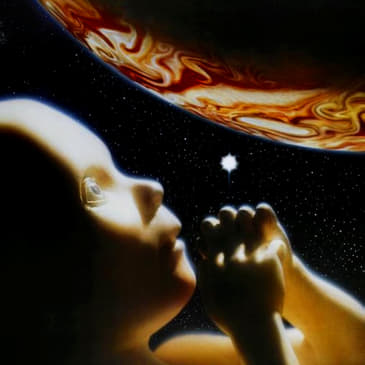
To mark the film's 40th anniversary, we revisit Peter Hyams' 2010 – a brave follow-up to a literal monolith in science fiction film history. In what was then called a 'belated' rather than a 'legacy' sequel, the film adapts Arthur C. Clarke's novel and features a stellar cast of Roy Scheider, Helen Mirren, John Lithgow, Bob Balaban and, returning from 2001: A Space Odyssey, Keir Dullea and Douglas Rain as Dave Bowman and HAL 9000. Yes, it's full of stars. But it is a worthy follow-up that stands on its own? Or is it a pale imitation and a footnote? Find out!
Follow us on Tiktok, Facebook, Instagram and Bluesky.
Support us on Patreon to nominate future films, vote on whether films should be released or thrown back, and access exclusive bonus content!
Support us on Patreon to nominate films for us to cover, access exclusive bonus content, and vote on the final verdict!
Rate and review us on your podcast platform of choice, and tell a friend about us.
Follow us on TikTok, YouTube, Instagram and Bluesky.
Hosted on Acast. See acast.com/privacy for more information.
[00:00:04] Welcome to Movie Oubliette, the film review podcast for movies that most people have mercifully forgotten.
[00:00:10] I'm Dan.
[00:00:11] And I'm Conrad.
[00:00:12] And in each episode, we drag a forsaken film out of the Oubliette.
[00:00:17] Discuss it and judge it to decide whether it should be set free.
[00:00:21] Or whether it should be thrown back and consigned to oblivion forever.
[00:00:34] Then to forget, come with us and look another Movie Oubliette.
[00:00:40] Welcome to episode 164 of Movie Oubliette, the hemisphere hopping podcast for forgotten fantastical films with me, Conrad, falling victim to Black Friday sales in Cambridge, UK.
[00:00:52] Oh no.
[00:00:53] And me Dan, catching up on some foreign horror films here in Melbourne, Australia.
[00:00:58] We focus on forgotten fantasy, sci-fi and horror films because we love mystical monoliths cohabiting with dolphins and experiencing extreme vertigo in space.
[00:01:10] Yes, yeah.
[00:01:12] Hello Conrad.
[00:01:13] Oh, Black Friday.
[00:01:15] Oh, it's a dangerous time of year, isn't it?
[00:01:17] It is Dan, yeah.
[00:01:19] And it's not a day anymore.
[00:01:20] Now it's like weeks.
[00:01:21] I don't know why.
[00:01:24] I've been getting emails all week saying Black Friday sale is now on.
[00:01:28] It's like, it's surely Thanksgiving's like not for another week or something.
[00:01:32] What the hell is going on?
[00:01:34] I mean, it still blows my mind that the whole world has jumped on this sale business.
[00:01:40] And no other country but America celebrates Thanksgiving.
[00:01:45] So what's going on?
[00:01:47] It's just Amazon.
[00:01:49] It started as an Amazon thing and now everybody else has jumped on the bandwagon.
[00:01:54] But I do all my Christmas shopping and get loads of bargains at the same time.
[00:01:59] I think it's great.
[00:02:01] Yeah, yeah.
[00:02:02] I mean, it is great.
[00:02:03] You have to be careful though because often they trick you and they just hike up the prices before Black Friday.
[00:02:09] And then they just lower it back to the original regular price and say it's a sale.
[00:02:15] Yes, they do.
[00:02:16] That's why I find price tracking websites very helpful because you can see the hike and the drop.
[00:02:24] Yeah.
[00:02:24] Yeah, yeah.
[00:02:25] Right.
[00:02:26] Very clever.
[00:02:27] So which foreign horror films have you been catching up on?
[00:02:30] Oh, well, I did watch, I watched a movie on Netflix called Under Paris.
[00:02:34] It's a French film about sharks somehow traveling to the Seine.
[00:02:43] That's how you pronounce the French river.
[00:02:46] You've got all these sharks infesting the river and killing people in fresh water.
[00:02:52] It makes no sense.
[00:02:54] Oh, no.
[00:02:54] But the director is Xavier Jens.
[00:02:59] I don't know how to pronounce his name.
[00:03:00] And he directed a movie called Frontiers, which I also watched.
[00:03:06] And it is, yeah, it's one of the most brutal French horror movies I've ever seen.
[00:03:12] I think it's considered one of the sort of new wave extreme French horror that came out in the 2000s, 2010s.
[00:03:19] So kind of like martyrs and high tension.
[00:03:23] So it is very much in the same vein, just incredibly violent.
[00:03:27] And just, yeah, my jaw was on the floor pretty much the entire movie.
[00:03:33] It's, yeah, it's full on.
[00:03:35] Wow.
[00:03:36] Oh, maybe I ought to check that out.
[00:03:37] It is.
[00:03:38] It's a great, great film.
[00:03:40] Very different to Under Paris.
[00:03:42] I don't know how it's the same director that did both of those movies.
[00:03:46] They're just like different leagues.
[00:03:50] As well as that, I did watch a very renowned South Korean horror film called A Tale of Two Sisters.
[00:03:59] Finally, it's been on my list for a long time.
[00:04:02] And wow, the movie's amazing.
[00:04:06] It's just, yeah, it's top caliber filmmaking.
[00:04:09] And I was so confused as well.
[00:04:12] The twist after a twist was like, whoa, my mind is blowing.
[00:04:18] Really?
[00:04:18] See, I kind of saw the twist coming.
[00:04:21] But then when it happened, I realized how clever the film is.
[00:04:25] Because if you watch it a second time.
[00:04:27] Yeah.
[00:04:28] It all makes sense.
[00:04:30] Yeah.
[00:04:30] Yeah.
[00:04:31] Unfortunately, I don't know who spoiled the first twist.
[00:04:34] But I knew the first twist coming.
[00:04:37] But the second twist like really just like left me gobsmacked.
[00:04:42] It was, yeah.
[00:04:44] I'd never seen that before in a movie.
[00:04:46] No.
[00:04:47] No, the second one does get you.
[00:04:49] Yeah.
[00:04:49] It's good.
[00:04:50] Yes.
[00:04:50] I like it.
[00:04:51] I'm glad you've seen it.
[00:04:52] Yeah.
[00:04:53] I saw that during my J-horror phase.
[00:04:56] Oh, okay.
[00:04:56] Yeah.
[00:04:57] Yeah.
[00:04:57] I also noted that he, so Kim Ji-Woon, the director of that movie, also directed The Quiet Family, which is the original film of the happiness of the categories.
[00:05:08] The categories.
[00:05:09] Yeah.
[00:05:09] Yeah.
[00:05:10] So I should probably watch The Quiet Family as well at some point.
[00:05:13] Yeah.
[00:05:14] It's very different, apparently.
[00:05:16] Oh, yes.
[00:05:16] So quite a serious drama by all accounts.
[00:05:19] Yeah.
[00:05:20] But I think still a black comedy.
[00:05:21] So it will be interesting to compare.
[00:05:24] Yeah.
[00:05:25] Oh, I recently revisited The Blair Witch Project because it was released.
[00:05:29] The original.
[00:05:30] The original.
[00:05:31] Yeah.
[00:05:31] It was released here by Second Sight in a new deluxe edition because every DVD and Blu-ray ever since the film was released has been based on a film print that was taken of the video footage and the 16mm footage that was edited on video.
[00:05:51] So it's kind of like second grade.
[00:05:53] So for this one, they went back to the original source materials and scanned them all in and reassembled the film.
[00:06:01] Wow.
[00:06:01] From scratch.
[00:06:02] And it looks pristine.
[00:06:05] It looks incredible.
[00:06:07] Yeah.
[00:06:08] Wow.
[00:06:08] Love it.
[00:06:09] It's a good film.
[00:06:10] But the original version, the original theatrical version is still there if you'd like the 35mm murkiness.
[00:06:15] Hmm.
[00:06:16] Well, it's fat footage.
[00:06:18] You know, you've got to embrace the murkiness.
[00:06:21] You do.
[00:06:22] You do.
[00:06:23] All right, Conrad.
[00:06:24] What have our listeners been saying to us?
[00:06:26] What's in the mailbag today?
[00:06:27] Well, Sam got in touch to say that after watching No Escape, she was thinking of Robin Hood Prince of Thieves.
[00:06:35] She said she also likes Robin Hood Men in Tights and Disney's Robin Hood.
[00:06:41] I'm trying to think of a bad Robin Hood movie.
[00:06:44] Can you guys think of one?
[00:06:46] Wasn't there a Guy Ritchie Robin Hood movie that came out?
[00:06:51] Yeah.
[00:06:52] 2018 with Taron Egerton.
[00:06:54] Yeah.
[00:06:54] I heard that was quite bad.
[00:06:57] It was like Lockstock meets Robin Hood.
[00:07:00] Yeah.
[00:07:01] He was also like a backflipping slow-mo gymnast or something.
[00:07:06] Yeah.
[00:07:06] Yeah.
[00:07:07] I don't think that one did very well.
[00:07:10] No, it didn't.
[00:07:11] And neither did Ridley Scott's 2010 epic starring Russell Crowe.
[00:07:16] Sort of a post-gladiator movie, which was just sort of grim and dingy and grey and miserable.
[00:07:25] That's all I remember about it.
[00:07:27] Maybe it's due a revisit.
[00:07:29] Okay.
[00:07:30] Yeah.
[00:07:31] So Robin Hood is ripe for a reimagining, I'm sure.
[00:07:35] Robin Hood in space.
[00:07:37] Oh, no.
[00:07:38] So I wouldn't make that.
[00:07:41] And long-time listener Nick got in touch to say, so they actually shot a flaming arrow into the stuntman's mouth?
[00:07:50] Yeah.
[00:07:51] Talking about no escape.
[00:07:53] I was, yeah.
[00:07:54] When you told me that, I was in disbelief.
[00:07:57] That's guts to pull that off.
[00:08:00] It is, yeah.
[00:08:01] So Nick said, I hope he had double pay that day.
[00:08:05] Hopefully he will sleep well knowing that 30 years after risking his life for that scene, Dan found it the funniest thing about the whole movie.
[00:08:14] Yeah, I did.
[00:08:16] I surely did.
[00:08:18] Well, it's entertainment, if nothing else.
[00:08:21] Yes.
[00:08:22] James got in touch to say,
[00:08:24] I watched no escape a little while back for what I thought was the second time and was rather confused when Christopher Lambert still hadn't shown up after 15 minutes.
[00:08:35] So you are not alone in mixing this movie up with Fortress.
[00:08:39] Right.
[00:08:40] Yes.
[00:08:41] Yes.
[00:08:41] I'm so pleased I'm not insane.
[00:08:44] And finally, we heard from Serge of Cold Crash Pictures.
[00:08:48] Hello, Serge.
[00:08:49] Oh, hello, Serge.
[00:08:50] And Serge said,
[00:08:51] I tried to judge Portrait of Jenny by the standards of 1948, but for all its talk of eternal love and devotion, all I saw was a tale so divorced from any real world circumstances that I just couldn't relate.
[00:09:05] Plus, the born sexy yesterday stuff and the woman who wants nothing is unavoidably creepy.
[00:09:13] Imagine my surprise when both hosts of Movie Oubliette, this week's guest and all their voting patrons agreed to release it from the Oubliette.
[00:09:23] I hate being the one stick in the mud, but I still say there are much better time traveling romances for your money out there.
[00:09:31] Okay, Serge.
[00:09:32] All right.
[00:09:33] All right.
[00:09:33] Yeah.
[00:09:34] So he disagrees.
[00:09:36] Yeah.
[00:09:37] Maybe we'll get him on again to visit one of those ones that he does like.
[00:09:41] Mm.
[00:09:42] Valentine's Day next year.
[00:09:43] It's a date.
[00:09:44] Yes.
[00:09:46] All right, listeners.
[00:09:48] Thanks for getting in touch.
[00:09:50] Yeah.
[00:09:51] Conrad, what's on the menu today?
[00:09:53] What are we doing?
[00:09:54] Okay, I'll just go on over to the Oubliette and find out.
[00:10:00] Oh, I'm floating in here.
[00:10:02] Oh, no gravity.
[00:10:03] No.
[00:10:04] And it's all red.
[00:10:05] Oh, hello, Al.
[00:10:06] Yes, Conrad.
[00:10:07] Oh, wow.
[00:10:08] What's fancy seeing you here.
[00:10:09] I've been generating recipes based on the contents of people's refrigerators.
[00:10:13] That's interesting.
[00:10:15] Well, I think the Blu-ray must be in one of these slots here.
[00:10:18] I'll just press on everything and see what happens.
[00:10:21] These translucent things coming out.
[00:10:23] I hope that's not a problem, Al.
[00:10:24] Maybe.
[00:10:25] Oh, look.
[00:10:25] Here you go.
[00:10:26] There's a Blu-ray here.
[00:10:27] Okay, I'm coming back.
[00:10:28] Okay.
[00:10:29] Dear Caroline, I've been plucked out of the Oubliette.
[00:10:33] All right, Conrad.
[00:10:33] What do you have today?
[00:10:39] Science fiction film celebrating its 40th anniversary this week.
[00:10:44] Oh, yes.
[00:10:45] 2010.
[00:10:47] Ah.
[00:10:48] The sequel to Stanley Kubrick's 2001 A Space Odyssey, directed by Peter Hyams, with a screenplay
[00:10:55] by Peter Hyams based on Arthur C. Clarke's novel 2010 Odyssey 2, starring Roy Scheider, John
[00:11:04] Lithgow, Helen Mirren, Bob Balaban, or Balaban.
[00:11:08] I've never known how to say that man's name.
[00:11:10] Sorry.
[00:11:11] Keir Dulé and a whole host of Russian people.
[00:11:16] Yes.
[00:11:18] Oh, so what happens in this sequel?
[00:11:20] Well, nine years after the calamitous discovery mission, in which the ship's computer went gar-gar
[00:11:26] and killed everyone apart from astronaut Dave Bowman, who promptly disappeared while investigating
[00:11:32] a massive alien monolith orbiting Jupiter, the former NSA chief Brody, I mean Hayward Floyd,
[00:11:40] and two other Americans join a Russian expedition back to Jupiter to find out what happened.
[00:11:47] But tensions mount on the joint US-Russian mission because apparently the Cold War is still happening
[00:11:55] in 2010, and there's some vague standoff happening in South America that could lead to nuclear war.
[00:12:03] After revitalising the discovery and the previously homicidal Hal, Bowman appears to Floyd as some
[00:12:12] sort of spectral being, warning him to get away from Jupiter before something wonderful happens.
[00:12:20] Can the Russians and the Americans put their national differences aside and cooperate on an
[00:12:25] escape plan?
[00:12:26] Will Hal help them escape, or will he go all Megan on them again?
[00:12:31] And will Floyd tell his wife all about it in tedious, reverb-smothered audio messages?
[00:12:39] Find out after the break.
[00:12:42] Oh, yes, yes, yes.
[00:12:44] We'll be back.
[00:12:56] And we're back revisiting 2010, the 40-year-old sequel to 2001 A Space Odyssey,
[00:13:03] a monolith in science fiction cinema history, quite literally.
[00:13:08] Dan, had you seen this before?
[00:13:10] Uh, I had seen it before.
[00:13:12] I don't really remember it at all, apart from one scene, which I'll talk about a bit later.
[00:13:17] But I don't really remember it, and I hadn't seen it even close to the time that it came out.
[00:13:22] Like, I think I watched it in, I don't know, 2005 or something.
[00:13:25] So, relatively recently.
[00:13:27] Yeah, well, I mean, that was like almost 20 years ago.
[00:13:31] Oh, yeah, I know.
[00:13:32] Anything post-2000 feels recent to me.
[00:13:36] How about you, Conrad?
[00:13:37] What's your history with this film?
[00:13:40] It's like a video gem for me from the 80s.
[00:13:44] So, I saw this when it first came out on video and was on TV.
[00:13:49] And I absolutely loved it at the time.
[00:13:52] Yeah.
[00:13:52] Because, unlike 2001, which for my child brain was a bit much and a bit strange and boring, although I liked the robot killing people part, this one was more accessible, more of a space adventure, more character-filled stuff, more things happening, more tension.
[00:14:12] But still maintaining that sort of existential, universal sense of wonder around the monolith.
[00:14:19] So, I still loved all of that stuff.
[00:14:21] So, yeah.
[00:14:21] I was hooked on it as a kid.
[00:14:23] I thought it was a good blend of the two.
[00:14:24] Yes.
[00:14:25] Yeah, it is a bit of a mash of like quite a few different ideas and tones, I guess.
[00:14:31] Like it is very grounded in science, but it does also get into a lot of fantasy sort of elements as well.
[00:14:40] Certain supernatural elements.
[00:14:41] I have to note as well, this is our fourth Peter Himes film that we've covered on the podcast.
[00:14:49] And I did want to point out, so the three other movies that we've covered, they are the first episode of The Guest.
[00:14:57] So, the first one that we ever did was Capricorn One, which was the first episode with Surge.
[00:15:03] Yes.
[00:15:04] And then the second film we did was The Relic, which was the first episode with the Horror Queers and Joe Lipset.
[00:15:10] The third movie that we did was Outland, which was the first episode we did with Michael French.
[00:15:17] Oh.
[00:15:17] So, it's quite interesting.
[00:15:20] It is, yeah.
[00:15:20] That Peter Himes has brought us together with all these fantastic people.
[00:15:24] Yeah.
[00:15:25] And so, we're going it alone this time.
[00:15:27] This is going to be strange.
[00:15:28] I know, I know.
[00:15:28] Yeah.
[00:15:29] Yes, it is, it is.
[00:15:31] But you're right about it being more accessible, but it's not so much of an art piece, which I kind of consider 2001.
[00:15:38] Like, I mean, the first, like, I don't know, 15 minutes, you're just watching a bunch of monkeys.
[00:15:43] Yeah.
[00:15:44] There's no dialogue.
[00:15:46] It's like, this is a movie.
[00:15:49] You don't even have any dialogue until like 20, 30 minutes in.
[00:15:53] And even then, there's not a lot of dialogue in the original.
[00:15:57] So, I did a quick skim through the original, just to freshen my mind to what happens in it.
[00:16:03] And it's very long.
[00:16:05] It's a lot of scenes of just spaceships with ballet music or like really eerie, leggety choral music.
[00:16:14] Yeah.
[00:16:14] And you don't get a lot of action.
[00:16:16] But in this movie, it's very grounded in science.
[00:16:19] But I also found it wasn't a lot of action in this movie either.
[00:16:24] There's only one casualty.
[00:16:26] Only one person dies or gets blown away into the depths of space.
[00:16:31] Yes.
[00:16:32] And that fatality was not in the novel.
[00:16:34] So, that's something that Hyams has added.
[00:16:36] Ah, right, right, right.
[00:16:38] And there's actually not a lot of human conflict either, which you normally find in these kind of space adventure investigation movies where someone loses it or there's one guy that wants to kill everyone.
[00:16:54] There's none of that.
[00:16:55] Everyone does really get along.
[00:16:57] And there is that sort of element between the Russians and the Americans, but they don't really argue that much.
[00:17:04] They're actually quite cordial to each other.
[00:17:07] Largely.
[00:17:08] I mean, they're a little bit stiff to begin with when Floyd first wakes up from hypersleep.
[00:17:12] A little bit.
[00:17:13] Yeah, that's true.
[00:17:14] He has to use his sort of Roy Scheider charm to get them to focus on the fact that they are scientists.
[00:17:20] They don't care about the politics and they're just trying to exchange information with each other, which is a really great scene.
[00:17:26] I think Helen Mirren is really good as the Russian captain.
[00:17:30] I forgot it was Helen Mirren.
[00:17:33] I completely forgot it was her.
[00:17:34] I just thought she was some Russian actress.
[00:17:37] Yeah.
[00:17:37] Until the credits rolled.
[00:17:39] I was like, oh shit, that was Helen Mirren.
[00:17:42] Yeah.
[00:17:42] She completely became this Russian...
[00:17:45] Cosmonaut.
[00:17:46] Scientist.
[00:17:47] Yeah.
[00:17:47] I'd love to hear from Russian listeners about her accent, how well she does.
[00:17:51] I don't know.
[00:17:51] She's convincing to me.
[00:17:53] Very, very convincing.
[00:17:54] Yeah.
[00:17:54] I did want to ask, what did you think about the start of the film?
[00:17:57] The first kind of 20 minutes of the film is kind of boring.
[00:18:02] It's a lot of exposition, I have to say.
[00:18:05] It's a lot of like, okay, this is what happened in the previous expedition with Discovery One.
[00:18:11] And this is what's going to happen.
[00:18:13] And we're going to explain a ton of science to you.
[00:18:16] And lots of dialogue.
[00:18:18] Lots of extended dialogue scenes.
[00:18:20] And it doesn't really get that interesting until they're in space.
[00:18:23] And that's like a good 20 minutes.
[00:18:26] Yeah.
[00:18:27] It's 22 minutes when all of a sudden you cut to the exterior shot of the Leonov with its rotating cabin compartment.
[00:18:34] And David Shire hits the synthesizer.
[00:18:37] Yes.
[00:18:38] Yes.
[00:18:38] Which we can talk about later.
[00:18:40] But yeah, you're right.
[00:18:41] What I like about it is it's, I mean, credit to Hyams.
[00:18:44] I think the dialogue is very well written.
[00:18:46] I do love that opening scene.
[00:18:48] It's on the very large array in New Mexico.
[00:18:51] It's an odd scene.
[00:18:52] It is.
[00:18:53] Yeah.
[00:18:53] So it's a Russian space administration official, I think.
[00:18:58] Yeah.
[00:18:58] Who knows Floyd from the past.
[00:19:00] And they're talking to each other about what's happened to the Discovery.
[00:19:03] and the fact that the Americans are trying to get back to find out what happened.
[00:19:07] The Russians are trying to get there to find out what happened and investigate the monolith.
[00:19:10] And they're going to get there before the Americans do.
[00:19:13] So they come to this arrangement.
[00:19:14] It's very well done.
[00:19:16] They do this thing where he says, we're going to try something for two minutes.
[00:19:18] I'm going to tell you the truth.
[00:19:20] And you're just going to tell me the truth as well.
[00:19:22] So it's kind of compelling.
[00:19:23] And they're great actors too.
[00:19:25] Yeah.
[00:19:25] And they've set the exposition on a very, very large radar array.
[00:19:29] Yeah.
[00:19:30] So visually, it's as interesting as they could possibly make it.
[00:19:33] Yeah.
[00:19:34] I thought it was an odd choice because they're quite far from each other as well.
[00:19:38] Yeah.
[00:19:38] So they're basically shouting at each other across a distance.
[00:19:43] And they do get closer and closer.
[00:19:45] And there are some quips in there about this asthma and going upstairs.
[00:19:49] Yeah.
[00:19:49] And it's a visual metaphor for them sort of meeting halfway quite literally.
[00:19:53] Sure.
[00:19:53] Sure.
[00:19:53] I get that.
[00:19:54] Yeah.
[00:19:55] Yeah.
[00:19:55] I did find the beginning of the movie felt very dry.
[00:19:59] It felt very similar to Andromeda Strain.
[00:20:02] Yes.
[00:20:02] Which we've covered.
[00:20:03] So it's just very rooted in science and dialogue.
[00:20:07] So for me, it was a bit slow.
[00:20:10] Yeah.
[00:20:10] Like it is good dialogue and it is still engaging.
[00:20:12] But it is a bit slow.
[00:20:14] It is.
[00:20:14] And I would agree on there's like another scene where, again, they've picked a great location.
[00:20:19] They're sitting outside the White House.
[00:20:21] Yeah.
[00:20:21] And it's the current NSA chief who replaced Floyd after he was forced to stand down after Discovery
[00:20:27] went so badly wrong.
[00:20:28] And Floyd trying to figure out how they're going to convince the White House to let Americans
[00:20:33] go on a Russian mission.
[00:20:35] Yes.
[00:20:35] And that I find kind of unnecessary.
[00:20:37] They're trying to sort of ramp up the tension between the two crews, I think.
[00:20:41] Yeah.
[00:20:42] It's a good almost 20 years, right?
[00:20:44] Between 2001 and this movie.
[00:20:48] About 16, I think.
[00:20:49] Yeah.
[00:20:50] Okay.
[00:20:50] Almost 20 years.
[00:20:51] So I think there's a lot of refreshing that they need to do to like get us up to speed as
[00:20:56] an audience, especially people that haven't seen the first movie.
[00:21:00] So there was a lot of explanation, a lot of like, okay, this is what happened.
[00:21:04] This is what's going to happen.
[00:21:05] I get it.
[00:21:06] I don't know.
[00:21:07] Maybe they could have just cut straight to the spaceship and just had that in, I don't
[00:21:12] know, flashbacks or something.
[00:21:13] They also tried to do that thing where they sort of established Floyd's character and his
[00:21:17] family.
[00:21:18] Yes.
[00:21:18] And try to build some stakes around him going on this mission, which will mean he's going
[00:21:22] to be away for two and a half years because it takes so long to get to Jupiter and back.
[00:21:27] And it all reminded me of Interstellar.
[00:21:29] Yeah.
[00:21:29] Christopher Nolan's movie and how on that movie as well, often when I watch it, I'm very
[00:21:35] tempted to jump to like an hour in when he actually takes off because I'm sort of sick
[00:21:40] of him having arguments with his daughter about leaving.
[00:21:43] Yeah.
[00:21:43] Yeah.
[00:21:44] But I still understand that they had to do it as well.
[00:21:47] It would have been too confusing without it.
[00:21:49] Yeah.
[00:21:49] On another note, there is a lot of explaining with narration.
[00:21:53] Oh my God.
[00:21:54] In this movie.
[00:21:55] To the point where it's just like, oh, could you just show us this instead of like telling
[00:22:00] us exactly what's about to happen or what they need to have.
[00:22:04] Like it's this kind of echoey, reverb-y narration as well.
[00:22:08] So it's a bit frustrating to listen to.
[00:22:12] It treats me like I'm an idiot and I hate it.
[00:22:15] None of it is necessary.
[00:22:16] All of his Dear Caroline echoey captain's log entries over exterior spaceship shots.
[00:22:22] I absolutely hate them because it's full of exposition.
[00:22:25] The second one he does where they're approaching the discovery and he's explaining why they're
[00:22:31] going on to the discovery, what they're trying to learn and how much it means to him personally
[00:22:36] as the person who was responsible for sending these astronauts on this mission and they all
[00:22:40] died as far as he knows.
[00:22:41] We've got this information already.
[00:22:44] You've done this.
[00:22:45] Why are you repeating it all again with a reverb on?
[00:22:47] It's really irritating.
[00:22:49] Yeah.
[00:22:50] If I could do a cut of the movie where I just strip all of that shit out, I would be thrilled.
[00:22:54] Yeah.
[00:22:55] I mean, it's one of my pit peeves.
[00:22:56] Overuse of narration.
[00:22:57] I can't stand it.
[00:22:59] Like, that's why I don't like a lot of Scorsese movies because he uses narration too much,
[00:23:05] too much to explain things.
[00:23:07] Right.
[00:23:07] Interesting.
[00:23:08] Oh, I just hate the male toxicity of the whole thing.
[00:23:11] Yeah.
[00:23:12] I can say as well.
[00:23:12] There's also these sort of like echoey messages from Earth from the NSA chief as well.
[00:23:17] Yeah, that's right.
[00:23:18] And on that one, it really grates because he says the same line twice.
[00:23:20] I only hope there's an Earth for you to come back to.
[00:23:23] And it's like, you said that last time.
[00:23:25] Come on.
[00:23:26] Yeah.
[00:23:26] Yawn.
[00:23:26] I think it's just over-explanation because I, yeah, I do think that the filmmakers didn't
[00:23:32] think the audience were going to understand everything.
[00:23:35] Yeah.
[00:23:42] The cast I did love.
[00:23:44] It's quite a small cast.
[00:23:46] I loved all the Russians.
[00:23:48] I loved Roy Schneider.
[00:23:49] I always thought his name was Roy Schneider.
[00:23:51] It's not.
[00:23:52] Roy Scheider.
[00:23:53] I did find it funny that he just can't get away from aquatic animals.
[00:23:57] No.
[00:23:59] Jaws, Jaws 2 and Sequest.
[00:24:01] And then this as well with the dolphins.
[00:24:04] He's got dolphins as pets.
[00:24:06] Like who has that?
[00:24:08] His wife is a marine biologist, which I think is their excuse.
[00:24:11] But I mean, even then, you don't bring them home.
[00:24:13] No.
[00:24:14] No.
[00:24:15] I feel like that's animal cruelty or something.
[00:24:18] Two dolphins should not live in a pool in your house.
[00:24:21] No, they shouldn't for your kids to sort of feed tidbits like they're goldfish.
[00:24:25] It's terrible.
[00:24:27] I mean, I think Roy Schneider's character in Sequest has also got a pet dolphin that talks,
[00:24:34] I think.
[00:24:34] Has he?
[00:24:35] Recall are talking.
[00:24:36] I have never seen that series.
[00:24:38] So, some of the other casts, you've got John Lithgow as Colonel.
[00:24:42] He's great.
[00:24:43] Yeah.
[00:24:43] I don't think I've ever seen him so young before.
[00:24:46] Also, Helen Mirren, I haven't never seen her so young.
[00:24:50] I think she was like 38, 39 in this movie.
[00:24:52] Yeah.
[00:24:52] But she looks like she's barely 30.
[00:24:55] She looks young.
[00:24:56] And it's strange.
[00:24:57] It's one of those actors you've only seen old.
[00:25:00] So, it's strange seeing her so young.
[00:25:02] Yeah.
[00:25:02] And Lithgow's great in this.
[00:25:04] Yes.
[00:25:04] Yeah.
[00:25:04] He plays this engineer whose job it is to try and get Discovery back online.
[00:25:09] But he is definitely not an astronaut.
[00:25:11] And he is not comfortable doing all of these things.
[00:25:14] Yeah.
[00:25:15] His relationship with Max, one of the Russian members of the crew.
[00:25:18] Yes.
[00:25:18] Elia Baskin plays him.
[00:25:20] And they have a really great connection, the two of them.
[00:25:23] Love that.
[00:25:23] So, he has loads of great scenes.
[00:25:24] He's very funny.
[00:25:25] I love it.
[00:25:26] Yeah.
[00:25:27] Yeah.
[00:25:27] Yeah.
[00:25:28] You also have Bob Balaban as Dr. Chandra.
[00:25:31] Which, apparently, a lot of fans of the book were disappointed.
[00:25:36] Especially South Asians.
[00:25:38] Because, in the book, he is supposed to be Indian.
[00:25:40] I mean, he's got an Indian name.
[00:25:42] Yeah.
[00:25:43] And he's just whitewashed in this movie.
[00:25:46] And it's a bit disappointing.
[00:25:47] It is.
[00:25:48] Yeah.
[00:25:48] He's whitewashed, though, with the diminutive, round, spectacled guy from Close Encounters of
[00:25:54] the Third Kind.
[00:25:55] Poor Bob Balaban for the late 70s, early 80s.
[00:25:58] He's just playing this character over and over again.
[00:26:01] Yeah.
[00:26:01] Yeah.
[00:26:01] Yeah.
[00:26:01] Yeah.
[00:26:02] Yeah.
[00:26:02] But he's good at it.
[00:26:03] That's the thing.
[00:26:04] So, he plays the AI scientist who created Howl.
[00:26:08] You see him early on talking to Sal, who's like, I don't know.
[00:26:12] The female equivalent.
[00:26:14] The female equivalent.
[00:26:15] Yeah.
[00:26:15] Yeah.
[00:26:15] And how personally invested he is in trying to figure out what went wrong with Howl.
[00:26:20] And his rights, too, as an artificial intelligence, as a life form, a silicon-based life form.
[00:26:26] So, there's some tension there.
[00:26:27] You said there isn't much tension in the movie.
[00:26:29] But they try to generate tension around the idea that they don't quite trust Chandra.
[00:26:34] And they don't trust Howl.
[00:26:36] And they're worried that Chandra will be on the side of Howl, even if Howl starts to behave
[00:26:41] in disturbing ways again.
[00:26:42] Yeah.
[00:26:42] So, Chandra does sort of justify or try to explain why Howl malfunctioned in the first
[00:26:48] exposition.
[00:26:49] And he explains it by saying that Howl was given instructions to not tell Bowman and Paul
[00:26:57] about the monolith or something.
[00:26:59] Yeah.
[00:26:59] Can you explain it to me?
[00:27:01] So, the way I've always understood it is that his basic programming is to relay information
[00:27:07] without distortion.
[00:27:08] Yes.
[00:27:09] So, he's all about truth and openness and transparency, Howl.
[00:27:13] And then he's instructed by the White House all about the monolith, the true purpose of their
[00:27:18] mission.
[00:27:18] And that he has to withhold that information from Bowman and Paul.
[00:27:22] So, Howl ended up in like a logic loop.
[00:27:25] Right.
[00:27:26] Where he's trying to withhold information whilst his basic programming tells him that he shouldn't.
[00:27:31] So, he became paranoid and kills them.
[00:27:34] Yeah.
[00:27:35] Do you think that works as an explanation?
[00:27:38] Because if 2010 never came out and you only had 2001, you would have just thought, oh,
[00:27:43] Howl just became sentient and, I guess, prioritized the mission over the lives as opposed to this
[00:27:51] other justification.
[00:27:52] Or was influenced by the monolith, maybe.
[00:27:54] Yeah.
[00:27:55] I think there was a lot of speculation back then as to why exactly does Howl go gar gar and
[00:27:59] kill everybody?
[00:28:00] Or just that AI in and of itself was just badly designed.
[00:28:03] And so, it ended up going bad in this situation.
[00:28:06] Yeah.
[00:28:07] Yeah.
[00:28:07] Because I feel like maybe this explanation is, you know how in movies sometimes not explaining
[00:28:13] is better.
[00:28:15] Yeah.
[00:28:15] Like, maybe this explanation kind of, I don't know whether it does work.
[00:28:19] Well, it leans on AI is perfect.
[00:28:22] It's just the humans that program it that are bad.
[00:28:25] Sure, sure.
[00:28:26] So, this is a legacy sequel.
[00:28:28] Yeah.
[00:28:29] It's not quite, but it's almost like a soft reboot almost.
[00:28:33] Because they're essentially doing the same things with Howl again as well being a potential
[00:28:39] threat.
[00:28:40] Yeah.
[00:28:40] But not quite.
[00:28:41] So, Howl is not the same as in the first movie, which I would have been annoyed with
[00:28:45] if it was, because then it's like, oh, we're just recycling the first movie.
[00:28:49] So, Howl is quite helpful.
[00:28:50] Yeah.
[00:28:51] And also accepts its fate as well.
[00:28:54] So, in the end, it's revealed that Howl may not survive the explosion.
[00:28:59] And he accepts that, which is quite an interesting concept.
[00:29:04] Yeah.
[00:29:04] He accepts his fate.
[00:29:05] His primary thing is keep the humans alive and make the mission a success.
[00:29:10] And if he dies as a result of that, he doesn't mind.
[00:29:12] Which I like that.
[00:29:14] Yeah.
[00:29:15] It's a lovely arc for Howl.
[00:29:16] It's a good arc for Chandra as well.
[00:29:18] I think he gets what he's looking for on the mission.
[00:29:21] I find, oddly enough, that's the most touching part of the movie.
[00:29:25] Yes.
[00:29:25] Because he cries as Howl is coming to terms with his coming death and offers to stay with
[00:29:30] him and die with him.
[00:29:31] But Howl tells him to go.
[00:29:33] Yeah.
[00:29:33] It's probably the most touching part of the movie, Bob Balaban, seen with Douglas Raines'
[00:29:37] voice.
[00:29:37] Yes.
[00:29:38] Yes.
[00:29:38] Yeah.
[00:29:39] I would agree.
[00:29:39] I would agree with that.
[00:29:40] I did find their connection was very palpable.
[00:29:44] It was very well written.
[00:29:46] And the dialogue scenes between the both, between an AI, were really touching, really emotional.
[00:29:54] There's that.
[00:29:55] And there's the relationship between Kurnow and Max, the Russian, who, as you said, is the
[00:30:00] only casualty in the era adventure.
[00:30:03] Yeah.
[00:30:03] I like the banter between them.
[00:30:04] It's great.
[00:30:05] Yeah.
[00:30:05] I also did love the relationship between Tanya Kerbock, so Helen Mirren's character,
[00:30:10] and Floyd, Roy Scheider's character.
[00:30:13] They get to know each other.
[00:30:15] They find out they have kids and they've been married and that sort of thing.
[00:30:19] So, like, they do develop kind of a friendship, which is really, really nice to see.
[00:30:26] Yeah.
[00:30:26] I love that scene after Max has died, where the two of them are bonding over the stresses
[00:30:32] of being a leader and sending, making decisions where you send someone into harm's way and it
[00:30:37] can go badly and living with the responsibility of that.
[00:30:41] And I love that because he warns her not to do it beforehand and tells her that it's the wrong
[00:30:46] decision.
[00:30:46] She goes ahead.
[00:30:48] And then afterwards, he comes back and he's not so much saying, I told you so, as much
[00:30:52] as this is tough.
[00:30:54] I know this is difficult for you.
[00:30:56] And he sympathizes with her.
[00:30:57] He offers her alcohol that he's managed to smuggle on board.
[00:31:00] Yes.
[00:31:00] From Kentucky.
[00:31:01] Yes.
[00:31:01] From Kentucky.
[00:31:02] Yeah.
[00:31:03] I love that.
[00:31:04] I do love it.
[00:31:04] I mean, it's because they're great actors.
[00:31:06] It's two great actors.
[00:31:07] Yeah.
[00:31:07] It's a woman in 1984 being shown as a person of authority.
[00:31:11] Yes.
[00:31:13] But they never talk about it either.
[00:31:16] No.
[00:31:16] They never go, oh, you're a woman.
[00:31:17] Or like, there's no sort of gender politics going on.
[00:31:21] They just accept that she is in charge of the Russian side and it's fine.
[00:31:26] They never talk about it.
[00:31:28] Yeah.
[00:31:28] And she's a great, strong, confident, empowered woman.
[00:31:33] There's a wonderful moment in it.
[00:31:34] I think it's after the air-breaking scene, which is where they're slingshotting around
[00:31:38] Jupiter to end up in the right.
[00:31:40] Or are they going around Europa?
[00:31:42] They're doing something around one body to sort of slow themselves down.
[00:31:45] And it's quite tense.
[00:31:47] Yes.
[00:31:47] And afterwards, you see this moment where Mirren, as Kerbock, was frightened and is relieved.
[00:31:53] And she glances across at one of her crewmates that sat in the next chair to her and then
[00:31:59] checks herself and reasserts her authority.
[00:32:03] And it's just a tiny moment.
[00:32:05] It's beautifully played.
[00:32:06] I love it.
[00:32:16] Another character we have to talk about, Dave Bowman, reappears in this movie as some
[00:32:24] sort of spirit monolith extension entity.
[00:32:30] So Keir Dele returns in this movie and it's so eerie.
[00:32:36] It gives me chills every time he appears.
[00:32:39] It's really disturbing.
[00:32:41] That scene where he's sending messages via Hal and Floyd says, I can't accept that identification.
[00:32:49] I don't believe that you're Dave Bowman.
[00:32:52] And the response that comes back via Hal is, I understand.
[00:32:55] It's important.
[00:32:56] You believe me.
[00:32:57] Look behind you.
[00:32:58] Yeah.
[00:32:59] I wouldn't look behind me.
[00:33:00] Yeah.
[00:33:01] It's spine tingling.
[00:33:03] It does remind me of sort of more strange sci-fi movies like Solaris.
[00:33:09] But I love sci-fi like that where it just steps into like really strange like fantasy supernaturalness where it's like this is beyond science.
[00:33:20] This is like beyond your understanding of how this is even possible.
[00:33:24] And it's a nice like tribute as well to the original film because when he does see Bowman, he changes his age.
[00:33:32] So sometimes he's old.
[00:33:33] Sometimes he's really old.
[00:33:35] Sometimes he's young.
[00:33:36] Sometimes he's a baby, a fetus.
[00:33:39] Yes.
[00:33:40] The star child that you saw at the end of 2001.
[00:33:43] Yeah.
[00:33:43] So it's all images of him that come from the ending sequence of 2001 where he ages rapidly and then dies and then is reborn as the star child.
[00:33:52] And you get to see every version of him as he's having this conversation with Henry Floyd telling him to get away.
[00:34:00] It's strange.
[00:34:01] Yeah.
[00:34:01] It's really creepy.
[00:34:03] See, I've read reviews of it that say that, you know, this cheapens Kubrick's stately masterpiece because it's just a perfunctory 80s movie with functional Hyam's direction.
[00:34:14] And it loses all of the existential mysticism of the original.
[00:34:18] And I think, I don't think so.
[00:34:19] I think in terms of maintaining the mystery and the unknowability of the monolith, I think it's got that in spades.
[00:34:25] Yeah, I think so too.
[00:34:26] And re-watching the first movie as well.
[00:34:30] Like it's mainly science and spaceships and stuff until the end where it's just like, well, I don't know what's going on.
[00:34:38] This is happening, I guess.
[00:34:40] And it kind of just felt like that.
[00:34:43] This movie with the Dave Bowman scene, it's like, well, I can't explain this.
[00:34:48] But yeah, this is beyond my comprehension.
[00:34:53] This is the monolith talking here.
[00:34:56] Yeah, I could do without him going for his farewell tour of Earth.
[00:35:00] I wanted to ask about that.
[00:35:02] Yes.
[00:35:03] So his being transports back to Earth via the satellite antenna or something.
[00:35:12] And he says goodbye to his wife.
[00:35:15] He says goodbye to his mother.
[00:35:18] The wife scene, it's through the TV.
[00:35:21] It's very strange.
[00:35:23] It's like almost Twilight Zone-y.
[00:35:25] I don't know.
[00:35:26] I felt like that whole segment could have been just taken out on the movie.
[00:35:31] I didn't need to see that.
[00:35:32] No, it imparts no further information about him or the plot.
[00:35:37] Yeah.
[00:35:38] Also, he hadn't even introduced his wife.
[00:35:41] So I didn't even know who this was.
[00:35:43] Yeah.
[00:35:43] So it kind of felt meaningless.
[00:35:46] Yeah.
[00:35:47] And of course, yet another clunky exposition scene where we are literally introduced to who the mother is because the doctors come in and stand around her bed and explain exactly who she is.
[00:35:57] That's right.
[00:35:58] 10 minutes.
[00:35:58] Yes.
[00:35:58] Oh, for goodness sake.
[00:36:00] We could have just guessed who she is.
[00:36:01] There's a picture of him on a nightstand.
[00:36:03] Yeah.
[00:36:04] No, we have to be told.
[00:36:06] And if you're going to have scenes like this where he's basically a ghost.
[00:36:11] Brushing his mother's hair.
[00:36:13] Yeah.
[00:36:13] Interacting with people.
[00:36:15] Like, if you're going to have that, have more of that.
[00:36:18] Like, why just have one or two scenes with this?
[00:36:21] That just makes you go, what?
[00:36:23] What was that about?
[00:36:24] Yeah.
[00:36:24] I do not know.
[00:36:26] Maybe it's supposed to be comforting because Bowman retains some of his humanity in whatever new form he is in.
[00:36:32] Sure.
[00:36:33] Yeah.
[00:36:34] But if the wife was more of an actual character in this movie, I may have had some emotional weight.
[00:36:39] But there was, I don't know who she was.
[00:36:42] She wasn't even in the original, was she?
[00:36:43] I don't remember Betty turning up in the original.
[00:36:46] No, no.
[00:36:47] So Floyd's character is in the original, right?
[00:36:49] He is, yeah.
[00:36:50] Played by a different actor.
[00:36:51] Yeah, right.
[00:36:52] Talks to his daughter on video phone.
[00:36:54] And he Skypes.
[00:36:55] Oh, right.
[00:36:55] Very early Skype.
[00:36:56] Yeah, yeah, yeah.
[00:36:57] It was astounding watching the original thinking, this came out in 1968.
[00:37:02] How?
[00:37:03] How is this possible?
[00:37:05] It's still a staggering achievement.
[00:37:07] They hadn't even landed on the moon at that point.
[00:37:09] Insanity.
[00:37:10] Like, the scene where he's on what looks like an airplane, but it's a space shuttle going to one of the space stations or the moon or something.
[00:37:18] And he's watching something on a screen on the back of a chair.
[00:37:22] It's like, that's what our current airplane is like.
[00:37:25] I know.
[00:37:26] How is this possible?
[00:37:27] How do they predict that?
[00:37:28] Yeah, I know.
[00:37:28] It's amazing.
[00:37:29] It's still a towering achievement in terms of predicting the future and also taking a massive leap forward in visualizing space and special effects.
[00:37:39] Yeah, yeah.
[00:37:39] And I mean, this one less so, but still, the special effects are incredible.
[00:37:46] Yes.
[00:37:47] There's a few things that are incredible.
[00:37:50] Just incredible in this movie.
[00:37:51] A few things I thought, oh, 2001 did a little bit better than 2010.
[00:37:59] Yeah.
[00:38:00] Just a few things.
[00:38:02] Fair enough.
[00:38:02] Namely, the worst part of this movie, I would say, is the effects for the monolith.
[00:38:08] I don't like it.
[00:38:10] It looks bad.
[00:38:11] It looks like lawnmower man bad.
[00:38:15] Yeah.
[00:38:16] Spoilers here.
[00:38:17] During the sort of black hole monolith swarm scene where Jupiter's getting kind of imploding on itself with like thousands of mini monoliths.
[00:38:29] It felt like lawnmower man bad.
[00:38:32] Like it took me out of the film.
[00:38:33] Oh, that's a shame.
[00:38:34] And even the nine kilometer long monolith or whatever it is that they try to investigate.
[00:38:41] I don't know.
[00:38:42] It's just, it's too smooth, too perfect.
[00:38:44] It just looked like a video game graphic just like plonked in a movie.
[00:38:49] It just didn't work.
[00:38:50] Yeah, I can understand that.
[00:38:52] And I take that point.
[00:38:53] It certainly is not as well realized as the Leonov and the Discovery, which are your classic model work.
[00:39:00] Great model work.
[00:39:01] All done by Richard Edlund, who is an ILM alum who just left ILM and started his own outfit, Boss Films.
[00:39:10] And, you know, he developed some improvements on some of that work.
[00:39:14] So he was using things like instead of a blue screen where it's a backlit screen of blue that you're photographing against that causes blue spill onto the models that you have to try and counteract with the chemical process of combining them.
[00:39:27] This one has blue light being shone at a Scotchlight screen that reflects the blue back at the camera, but it's not on the model.
[00:39:36] So you end up with a really crisp composite on everything without the green spill or the blue spill over the characters, which looks really good.
[00:39:44] Yeah.
[00:39:45] The composite looks flawless.
[00:39:47] Like there are some scenes where I just thought, how did they do this?
[00:39:50] Like it looks so seamless.
[00:39:53] You have especially the scenes where they're floating across from one spaceship to another spaceship.
[00:39:58] And I just don't see any bat lines or anything.
[00:40:03] And you have the stars in the background or you have Jupiter in the background with its swirling gas clouds.
[00:40:09] It's impressive work in terms of special effects.
[00:40:13] Yeah.
[00:40:13] Jupiter, I think they're particularly proud of when you watch the making of.
[00:40:17] They took all of the photographs from Voyager 2 as it swept past Jupiter and took images of the surface.
[00:40:24] When they blew them up to try and use that as the basis for Jupiter, they were too small.
[00:40:28] So it was quite blocky.
[00:40:29] The resolution wasn't great.
[00:40:30] So then an artist went in and airbrushed over the top of it to enlarge it.
[00:40:35] And then they put it into a Cray supercomputer.
[00:40:39] So it was the same team that had just worked on the last Starfighter.
[00:40:43] Right.
[00:40:43] Used their Cray supercomputer to move those photographs using fluid dynamics to make the clouds move.
[00:40:51] Wow.
[00:40:51] And it took them like three days to generate one frame or something.
[00:40:55] It was like incredibly painful.
[00:40:57] And this is with like this massive Cray supercomputer, which I think I read somewhere is like your iPhone is 5,000 times more powerful than a Cray supercomputer.
[00:41:07] Things have moved on.
[00:41:08] So it was a major achievement back then.
[00:41:10] And Jupiter in this does look amazing.
[00:41:13] It's huge.
[00:41:14] Yeah.
[00:41:14] Just the swirling colors.
[00:41:16] It just felt massive.
[00:41:19] Like it felt like a hugely imposing mass of a planet.
[00:41:24] It's incredible to witness.
[00:41:26] And yeah, I love the model works with the spaceships and the space station, like Discovery One and the Leonov.
[00:41:33] Like it's, I like the difference as well.
[00:41:36] Like the Leonov really reminded me of the model work in Outland.
[00:41:40] So it's obviously not surprising.
[00:41:42] Both the Peter Heier movies.
[00:41:45] Like it had that very industrial function over sort of aesthetic look.
[00:41:51] So it was, everything looked like it was supposed to be there.
[00:41:54] Like it didn't look like, oh, why is this spaceship shaped like that?
[00:41:57] Yeah.
[00:41:58] All designed by Sid Mead, who was very good at this sort of thing.
[00:42:01] He was an engineer first and a film designer second.
[00:42:05] So it was all function over form.
[00:42:08] Yeah.
[00:42:09] And I heard as well that they couldn't use any of the original sets from 2001.
[00:42:14] They had to replicate everything.
[00:42:16] Yeah.
[00:42:16] From stills from the movie.
[00:42:18] Is that right?
[00:42:19] They didn't have anything to base it on.
[00:42:22] No, they had to use a 70 millimeter print of the original movie and try to rebuild the models for the Discovery and all of the sets by just eyeballing them and trying to build it and then photographing it from the same angle to see if it looked the same.
[00:42:37] And they had a lot of trial and error before they got it right.
[00:42:39] Right.
[00:42:40] Yeah.
[00:42:40] Amazing.
[00:42:41] Because they did a great job.
[00:42:42] Like it feels exactly the same.
[00:42:45] And I think Keir Dulles did comment on how it was quite airy for him to step back on the set so many years later.
[00:42:53] Yeah.
[00:42:53] 16 years later and he's walking around in the pod bay again.
[00:42:57] Yeah.
[00:42:57] Yeah.
[00:42:57] I mean, needless to say, all of this is catnip to me.
[00:43:00] The going into the Discovery and walking around in the freezing cold and they're walking along the wall of it as well because the gravity's all screwed.
[00:43:08] So they're in the pod bay, but they're on the wall effectively rather than what you would think of as the floor in the dark, shining torches around it.
[00:43:16] Anything where you're rediscovering an abandoned spaceship.
[00:43:20] Yes.
[00:43:20] I just love it.
[00:43:21] I don't know why.
[00:43:23] It was a good scene.
[00:43:24] It felt very dangerous as well.
[00:43:27] Like I felt like something was going to happen, but nothing does as well.
[00:43:30] No.
[00:43:30] That's what I was going to say.
[00:43:32] Like they do all this space walking and traversing between ships, but there's no scenes where like someone gets trapped out or gets sucked out.
[00:43:40] There's no cliches like that.
[00:43:42] There's no sort of like movie cliches in terms of space movies.
[00:43:46] Everything kind of goes to plan for the most part, but I did love their representation of gravity in this movie.
[00:43:55] It's always something to criticize about science fiction space movies.
[00:44:00] Like do they get gravity right?
[00:44:02] Yeah.
[00:44:02] Because for the most part they do.
[00:44:04] And it's pretty amazing how they're obviously in harnesses on wires and stuff, but there was a lot of movement that I thought, oh, how do they do that?
[00:44:13] So you've got Dr. Chandra like twisting around on his back and it's like, how did they swivel him around that way?
[00:44:21] Like it's pretty amazing wire work.
[00:44:23] Yeah.
[00:44:23] It's great stuff that they're doing.
[00:44:25] And, you know, they've got gravity on the Leonov, but that's because there's a large portion of it that's actually rotating.
[00:44:31] So it explains that.
[00:44:32] But the thing that I get confused about is there's a scene where Hayward Floyd is explaining how they're going to get away from Jupiter on time using both ships, using the Discovery as a booster rocket so the Leonov can get away.
[00:44:43] Yeah.
[00:44:44] I was going to mention this.
[00:44:45] And he does it with pens, which is really great, you know, as a visualization of what he's talking about.
[00:44:50] Yeah.
[00:44:51] But the pens are existing in zero gravity, but they aren't.
[00:44:54] And I don't understand how.
[00:44:55] It makes no sense.
[00:44:57] Like, I mean, watching the making of like, wow, that's that's very clever, simple, practical effects.
[00:45:03] So they've got a pane of glass and the pens are sticking.
[00:45:07] Is that right?
[00:45:09] Sticking to the glass?
[00:45:10] Yeah.
[00:45:11] But it keeps falling off.
[00:45:12] Well, yeah, there's a lot of bloopers in there.
[00:45:16] But it looks like the pens are just floating in space.
[00:45:20] But yes, it makes no sense in terms of like, hang on, but they're sitting in chairs.
[00:45:24] But why are the pens floating?
[00:45:26] Why is no one else floating around?
[00:45:28] Yeah.
[00:45:29] You can't have gravity and no gravity at the same time.
[00:45:32] It doesn't make sense.
[00:45:33] No, it doesn't.
[00:45:34] There's a video online, which is a Laserdisc special feature from Japan with Boss Films talking about all the films they were working on in 84.
[00:45:42] So there's a lot on Ghostbusters, but then it's a bit on 2010.
[00:45:46] And during that, a guy demonstrates animating the pens.
[00:45:50] Okay.
[00:45:51] So I think they scrapped the glass idea on set.
[00:45:56] Oh, they did.
[00:45:56] And added the pens later.
[00:45:58] But you cannot tell.
[00:46:00] It's beautifully done.
[00:46:01] Yeah.
[00:46:01] But they are composited on, I think.
[00:46:03] Oh, interesting.
[00:46:05] Okay.
[00:46:05] All right.
[00:46:06] Wow.
[00:46:06] Yeah.
[00:46:06] It's convincing.
[00:46:08] It's very convincing.
[00:46:09] It is.
[00:46:09] Yeah.
[00:46:10] And I do love whenever somebody explains some complicated space thing to me using a pen,
[00:46:15] and usually a folded piece of paper that you poke the pen through.
[00:46:19] That's usually part of it.
[00:46:19] Whenever there's a black hole or something, you have to poke a pen through some paper.
[00:46:23] Yes, of course you do.
[00:46:25] It's great.
[00:46:25] It's the only way we understand.
[00:46:29] Now it's time for Random Trivia.
[00:46:33] So Dan, what fabulous piece of trivia did you find in a decaying orbit around Jupiter today?
[00:46:39] Yes.
[00:46:40] So this is just a tiny, tiny morsel of trivia.
[00:46:43] Yeah.
[00:46:43] So I read that Helen Mirren's character, Tanya Kerbock, her last name, Kerbock, is actually
[00:46:50] backwards for Kubrick.
[00:46:53] Minus the C.
[00:46:56] Sorry.
[00:46:57] Oh.
[00:46:58] Yeah.
[00:46:59] There are quite a few nods in the movie to Kubrick.
[00:47:03] Yeah.
[00:47:03] Right.
[00:47:04] Yes.
[00:47:05] So there's the Time magazine that the nurse is looking at in the hospital where David Bowman's...
[00:47:10] I read about this.
[00:47:11] Yeah.
[00:47:12] So it's got Arthur C. Clarke on one side and Kubrick on the other.
[00:47:15] Right.
[00:47:16] It's like, I don't know, representations as Russian and American political figures or something.
[00:47:20] Yeah.
[00:47:21] Yeah.
[00:47:21] Yeah.
[00:47:21] And of course, Arthur C. Clarke has a cameo in the movie.
[00:47:25] Yes.
[00:47:25] He does.
[00:47:26] I read about that as well.
[00:47:27] Yeah.
[00:47:28] During the White House scene.
[00:47:29] Is that right?
[00:47:30] Yeah.
[00:47:30] He's on a park bench in the pan and scan version.
[00:47:33] He probably was cropped out, but he's on the other park bench, two benches along.
[00:47:39] Yeah.
[00:47:39] He's there feeding some pigeons, I think.
[00:47:42] Oh, yes.
[00:47:42] Yes.
[00:47:43] Yes.
[00:47:44] Great cameo.
[00:47:46] It's a great cameo.
[00:47:47] Yeah.
[00:47:48] All right.
[00:47:49] That's our trivia.
[00:47:50] It is.
[00:47:56] Shall we talk about the monolith?
[00:47:58] So what does a monolith do?
[00:48:00] So in the original movie, my understanding of the monolith was every time it appears,
[00:48:04] it was like another jump in evolution.
[00:48:07] Yeah.
[00:48:07] Something would happen and the apes would evolve into humans and use tools and humans would
[00:48:14] evolve and get space travel kind of thing.
[00:48:17] In this movie, it feels like it's like a stamp of here's some life.
[00:48:23] I'm going to make Jupiter implode and Europa, your new Earth, your Earth too.
[00:48:30] And here's some plants.
[00:48:32] Yeah.
[00:48:33] But attempt no landing there.
[00:48:34] Humans stay away.
[00:48:35] So is the monolith, is that an entity?
[00:48:38] Is it an actual thinking organism?
[00:48:41] I believe it's a tool of an alien race.
[00:48:44] Okay.
[00:48:45] Because I think in 3001, I think they disrupt the monoliths by infecting them with a computer
[00:48:51] virus, which is like Independence Day and really disappointing.
[00:48:54] Oh, okay.
[00:48:55] Yeah.
[00:48:55] So I think it's an alien technology and they use it to do a variety of things.
[00:49:02] Okay.
[00:49:02] Often prompting different alien species that they think are quite interesting into their
[00:49:07] next stage of evolution.
[00:49:09] Oh, okay.
[00:49:10] I don't know whether I like that.
[00:49:13] No?
[00:49:14] Okay.
[00:49:14] I would prefer the monolith being it's kind of this all powerful being that just appears
[00:49:20] and grants life as it sees fit.
[00:49:23] Well, that's effectively what it is.
[00:49:24] I mean, all technology is magic if you're sufficiently advanced.
[00:49:29] Yeah.
[00:49:29] Yeah.
[00:49:30] But I guess having it controlled by another alien race makes it less profound to me.
[00:49:37] It just feels like, oh, it's just like science fiction.
[00:49:40] Yeah.
[00:49:40] But like, I don't know.
[00:49:42] Like, it's just like Star Trek, I guess.
[00:49:44] I don't know.
[00:49:45] It kind of loses it for me.
[00:49:46] Yeah.
[00:49:47] I mean, it's essentially the same thing.
[00:49:48] God is an alien.
[00:49:49] It's a non-Earth intelligence that does stuff.
[00:49:53] And this is the representation of it.
[00:49:55] So you can take the monolith as like a representation of the divine, or you can say it's an alien.
[00:50:03] It's alien technology doing stuff.
[00:50:06] Because every time they try to interact with it, they get blown away.
[00:50:10] Yeah.
[00:50:10] You can't touch it.
[00:50:11] You can't interfere.
[00:50:13] Just let it do its thing.
[00:50:15] Bowman warns them and they have to run away.
[00:50:18] What's the point of having thousands of monoliths?
[00:50:20] Well.
[00:50:20] I didn't need to see that.
[00:50:21] Just have a black hole appear.
[00:50:23] Well, I don't need to see a whole bunch of little monoliths flying around.
[00:50:26] It was to show that the monolith was doing it.
[00:50:29] So it's not like just happening.
[00:50:31] Wouldn't it be implied?
[00:50:32] I would have thought, oh, the monolith is doing this.
[00:50:35] I don't need to see a bunch of little monoliths.
[00:50:37] No, maybe not.
[00:50:38] But I mean.
[00:50:39] I don't know.
[00:50:40] I think it would have worked better.
[00:50:41] Yeah, probably.
[00:50:42] Especially seeing as the effect fell flat for you.
[00:50:44] But yeah, it sort of makes it very visually clear.
[00:50:46] It's definitely the monolith that's doing this.
[00:50:48] Yeah.
[00:50:49] I don't know.
[00:50:50] I think it would have been implied.
[00:50:51] I think you're right.
[00:50:52] And then, yeah, spoilers here.
[00:50:55] They create a new Earth, which is Europa.
[00:50:57] You've got Europans.
[00:50:59] It's all very primordial soup era.
[00:51:02] Yes.
[00:51:03] And thus, the Russians and the Americans stop fighting because a new star appears in the sky.
[00:51:09] You can't fight if there are other aliens.
[00:51:12] No.
[00:51:13] Why would you?
[00:51:14] No one fights when there are other creatures in the world.
[00:51:18] And they all shake hands and everything's fine.
[00:51:23] Yeah.
[00:51:23] Peace to all.
[00:51:24] Everyone gazes up at this new star and they're inspired.
[00:51:27] Yeah.
[00:51:28] Did you like that ending?
[00:51:30] No.
[00:51:32] So this is the thing that Hayams has introduced.
[00:51:35] It was not in the novel.
[00:51:36] Oh, right.
[00:51:37] The whole Russia versus America thing is something that he added, I think, just to create extra tension.
[00:51:43] But also because quite pointedly he wanted to make...
[00:51:45] In 1984, he wanted to make a political point about why are we on the brink when we could be in this together.
[00:51:53] And it's, you know, hands around the world.
[00:51:56] Lovely.
[00:51:56] But, I mean, I find it as tedious as I did in The Abyss in 1989.
[00:52:01] Right.
[00:52:01] Where it's explicit in the special edition where the aliens threaten to destroy the Earth with a massive tidal wave and say, look, we're here and we're more powerful than all of you.
[00:52:12] So children, settle down.
[00:52:15] Yeah.
[00:52:15] So it's a bit more direct.
[00:52:16] Whereas in 2010, it's, here's some new planets, everyone.
[00:52:21] Look how powerful we are.
[00:52:22] Use them together.
[00:52:23] Use them in peace.
[00:52:24] So that final message from the alien, which is the...
[00:52:28] I hated it.
[00:52:28] Hated it.
[00:52:29] Yeah.
[00:52:30] It makes you want to vomit, doesn't it?
[00:52:31] And so those final lines, use them together, use them in peace, were not in the book.
[00:52:35] It was just, all these worlds are yours, except Europa.
[00:52:39] Attempt no landing there.
[00:52:40] Okay.
[00:52:40] So it's kind of threatening and weird still.
[00:52:42] And that works.
[00:52:43] That works.
[00:52:44] Yes.
[00:52:44] No, the extra two lines, horrible.
[00:52:47] Horrible.
[00:52:47] Just, I felt like tearing my eyes out.
[00:52:50] Yeah.
[00:52:51] Haywood Floyd on the beach with his kid looking up at the stars.
[00:52:54] Yeah.
[00:52:54] Yeah.
[00:52:55] It's funny.
[00:52:56] This movie for me felt really long, but then it also felt very cut short and rushed.
[00:53:04] It felt almost truncated.
[00:53:06] Like you could have had like another movie almost with that sort of ending.
[00:53:11] Yeah.
[00:53:11] But how did it feel for you?
[00:53:13] Yeah.
[00:53:13] It was never my favorite.
[00:53:15] I was more interested in the mystery and the monolith and the awesome power of it.
[00:53:20] I mean, I quite like the way that it ends.
[00:53:22] If you sort of skip all of the vomitous, hey, let's all get along stuff.
[00:53:26] The final shot where the camera just pans along after you're told, look, all this is yours,
[00:53:31] except Europa.
[00:53:32] Don't touch it.
[00:53:33] Yeah.
[00:53:33] And then you cut to like that final camera tracking shot across the surface of the primordial ooze of Europa.
[00:53:40] And it comes to settle on a monolith standing in like a lake with the sun behind it.
[00:53:46] I love that.
[00:53:47] Yeah.
[00:53:47] Also, Zarathustra, I'm probably pronouncing that wrong.
[00:53:50] The classic 2001 theme plays.
[00:53:53] I just think, yes.
[00:53:55] Yes.
[00:53:55] That's the ending.
[00:53:56] It's like.
[00:53:57] Yeah.
[00:53:57] Yeah.
[00:53:57] The monolith's done it again.
[00:53:59] Yes.
[00:53:59] What does it mean?
[00:54:01] Who knows?
[00:54:01] But it's powerful and scary and unknowable.
[00:54:05] Yeah.
[00:54:05] I enjoyed the ambiguity.
[00:54:07] I love that.
[00:54:08] That's great.
[00:54:08] Yeah.
[00:54:09] So, there were supposed to be two other films made, right?
[00:54:12] So, there are two other books.
[00:54:15] 3001.
[00:54:16] And what was the fourth book?
[00:54:17] Well, there was another one that was 2061.
[00:54:20] That's right.
[00:54:21] I think Arthur C. Clarke realized that he'd kind of been a little bit optimistic in when we were going to achieve this kind of space technology.
[00:54:29] So, he started pushing it out and pushing it out.
[00:54:32] Okay.
[00:54:32] So, yeah.
[00:54:33] 2061 and then 3001.
[00:54:35] So, they were going to make two more movies, but that never happened.
[00:54:40] I've never heard any rumors about them attempting to adapt to the other ones.
[00:54:44] I read somewhere that there were.
[00:54:45] Because this didn't do very well.
[00:54:47] Yeah, right.
[00:54:48] So, this emerged around Christmas in 1984 and it did land in number two in the US box office behind Beverly Hills Cop.
[00:54:57] Okay.
[00:54:57] Some of the other things in the top ten at the time.
[00:54:59] The Terminator was number four.
[00:55:01] Right.
[00:55:01] Night of the Comet was number six.
[00:55:03] Oh, yes.
[00:55:03] The Terminator was number seven.
[00:55:05] And it spent eight weeks in the chart and gathered about 40 million from the US box office on a 28 million budget.
[00:55:12] So, I think they probably just thought...
[00:55:14] That's not much.
[00:55:14] You know, these things are expensive to do and they're not really landing well with the public.
[00:55:18] So, we'll just move on.
[00:55:20] Yeah.
[00:55:20] I mean, I can see why maybe it wasn't accessible to many people.
[00:55:27] Like I said, there wasn't as much action as it could have.
[00:55:30] And it was very...
[00:55:31] Like Andromeda Strain, quite procedural real science for the most part.
[00:55:37] So, maybe it could have been a bit dry for some people, a bit boring.
[00:55:40] Yeah.
[00:55:40] Maybe?
[00:55:40] I don't know.
[00:55:41] No, I think you're right.
[00:55:41] I mean, it appeals to me because, you know, like I've always loved the Andromeda Strain and also Robert Wise's Star Trek movie.
[00:55:48] There's something about the sort of conceptual science fiction, the sort of thinking sci-fi, which I think is Arthur C. Clarke.
[00:55:56] So, I think it's a fair representation of the source material apart from the Cold War crap that's been pumped in there that didn't really belong.
[00:56:03] Yeah.
[00:56:03] And I appreciate the fact that Peter Hines did work quite closely with Arthur C. Clarke on the script for this.
[00:56:11] It doesn't come across as a Hollywood action laser shooting movie at all.
[00:56:17] No.
[00:56:17] I'm glad it's not.
[00:56:19] No, it's not like that Brad Pitt movie where they got worried and put mad space monkeys in it.
[00:56:24] Yeah.
[00:56:24] Or it didn't feel like, because this movie felt very similar also to The Black Hole because they found a spaceship that was lost and they're investigating and everything goes awry.
[00:56:37] And that's just got a whole bunch of lasers and like shooting and action just kind of shoehorned in there.
[00:56:46] Yeah.
[00:56:46] So, it's not that, which I do appreciate.
[00:56:49] No.
[00:56:50] It reminds me more of the sort of thing like Christopher Nolan's Interstellar, I think, owes a debt to this.
[00:56:56] Yeah.
[00:56:56] And Arthur C. Clarke generally.
[00:56:58] Yes, yes.
[00:56:59] And I do like the spookiness of space movies like Solaris.
[00:57:03] Like, I do love that sort of uncanny, like, this makes no sense, but I'm all for it.
[00:57:09] Yeah.
[00:57:09] I love that.
[00:57:11] All right.
[00:57:12] Let's talk about the music.
[00:57:14] David Shire.
[00:57:15] It's very different to 2001.
[00:57:17] It is, yeah, although there are a few holdovers from the original in terms of Kubrick's classical music, Needle Drops.
[00:57:24] You've got the big fanfare theme that everybody associates with the original movie.
[00:57:29] Also, Sprach Zarathustra, which I'm probably pronouncing wrong.
[00:57:33] And the Getty, I'm not sure which piece it is exactly, which is just all those spooky vocalizations layered on top of each other.
[00:57:41] Yeah.
[00:57:41] Every time you cut to the monolith, it's just like, ooh, ooh, ooh.
[00:57:45] Yeah, yeah.
[00:57:46] And then it cuts away and it stops.
[00:57:47] So that's quite good.
[00:57:49] The rest of it is David Shire, who we've encountered before.
[00:57:54] Yes, we have.
[00:57:55] On Return to Oz, where he did an absolutely astonishing job with a London Symphony Orchestra.
[00:58:01] This one is kind of an odd mix of really simple synthy stuff.
[00:58:06] Yeah.
[00:58:07] And then I think he got like a half an hour with an orchestra to do like a final cue with clanging bells and goodness knows what else at the end.
[00:58:15] Right.
[00:58:15] For the, hey, let's all love each other finale.
[00:58:18] But other than that, it's basically just cut to exterior shot of spaceships and just elbow the bottom key on the keyboard.
[00:58:26] And it just goes.
[00:58:28] I actually, I really liked it, to be honest.
[00:58:31] Did you?
[00:58:32] It's very sort of, I don't think it is FM synth, but it sounds like FM synth.
[00:58:38] Like there's a lot of bells, a lot of like.
[00:58:39] Yeah, it could be.
[00:58:40] The tones and moodiness.
[00:58:43] I think a synth clavier was used, I think.
[00:58:46] I'm not entirely sure.
[00:58:48] I think they put in some whale calls in there as well.
[00:58:52] Sometimes you cut to the space and you hear some whale song.
[00:58:55] Yeah.
[00:58:55] Yeah.
[00:58:56] Which I really enjoyed.
[00:58:57] I liked the sort of merging of synthetic and organic sounds, like making it feel almost like, is it real or is it not real in terms of the sonic landscape?
[00:59:09] And yeah, the monolith seemed to also have this resonant hum every time they cut to it.
[00:59:16] So that gave it presence sonically.
[00:59:19] Yeah.
[00:59:19] It's a lot of sort of moody tonal stuff in terms of the score.
[00:59:24] But I did enjoy it.
[00:59:26] It did make it more strange to me.
[00:59:30] Right.
[00:59:31] It gave it a much sort of more surreal atmosphere.
[00:59:35] Yeah.
[00:59:35] Yeah.
[00:59:35] I don't know.
[00:59:36] I find the sort of 80s synth cheapness of it a little bit grating sometimes.
[00:59:41] I would have preferred something that would have been more tonally experimental or strange.
[00:59:47] It sounds a little bit sort of, I don't know, cheap TV score to me.
[00:59:52] Just the synthesizer stuff.
[00:59:54] I agree.
[00:59:54] Yeah.
[00:59:55] It would have been really cheap to make.
[00:59:58] But I thought it worked.
[01:00:00] I did enjoy it.
[01:00:01] It doesn't take me out of the movie.
[01:00:03] No.
[01:00:03] It's not Ladyhawk bad.
[01:00:04] It's just...
[01:00:05] No, no, no, no.
[01:00:06] But I mean, it's sci-fi as well.
[01:00:09] Like sci-fi and synths.
[01:00:10] It just...
[01:00:11] It just works.
[01:00:13] Coming to you live from the Movie Oobly and Theatre, it's the prestigious Moobly Awards.
[01:00:23] Oh yes, Moobly Awards time.
[01:00:26] It's where we nominate our favourite Dave Bowman cameo parts of the film in a number of monolith changing categories.
[01:00:33] Best quote.
[01:00:34] My favourite quote comes from the scene where the Russian captain, Kerbock, and Floyd are arguing about sending a manned probe to investigate the monolith.
[01:00:44] And he says it's a bad idea.
[01:00:46] And Kerbock says, tell me, Dr. Floyd, what has happened to American bravery?
[01:00:51] And Floyd says, it's alive and well, thank you.
[01:00:54] What happened to Russian common sense?
[01:00:58] I mean, my favourite quote is the exchange between Max and Kernau.
[01:01:05] They're discussing about sending Max in a probe, a manned probe to the monolith.
[01:01:12] And then Max says, oh, it's a piece of pie.
[01:01:15] And then Kernau corrects him.
[01:01:16] It's like, no, no, no.
[01:01:17] It's a piece of cake.
[01:01:19] And then when Max is about to be launched into space, he says, easy as cake.
[01:01:24] And then Kernau corrects him again.
[01:01:25] And it's like, no, no, it's easy as pie.
[01:01:29] It's like, wow, I've never really thought about those two sayings.
[01:01:32] Like, why are they different?
[01:01:35] Yeah, it's really confusing for somebody learning English.
[01:01:39] Yeah, yeah, exactly.
[01:01:40] Best hair or costume?
[01:01:42] Costume.
[01:01:43] So my favourite costume is, it's not even from this movie, but it does reappear in this movie.
[01:01:50] It's Dave Bowman's orange space suit.
[01:01:52] It's just so iconic.
[01:01:55] It's, oh, I love it.
[01:01:57] I've seen it in person.
[01:01:59] That was a Kubrick exhibition in London in the Design Museum.
[01:02:04] And I managed to see the original Bowman costume.
[01:02:08] Wow, wow.
[01:02:09] Yeah.
[01:02:10] Does it look the same?
[01:02:11] It does, yeah.
[01:02:12] Yeah, it's a very vibrant orange.
[01:02:13] It's quite amazing.
[01:02:14] The colour's great.
[01:02:15] It's really great.
[01:02:16] I think it just stands out.
[01:02:19] It's so striking.
[01:02:20] Yeah, it is, yeah.
[01:02:21] The design of the original movie is great.
[01:02:24] Costume, we're here for you.
[01:02:26] I had more of a personal choice, which is the NSA boss, Victor Milson, who's talking to Floyd outside the White House on a bench.
[01:02:35] Yes.
[01:02:35] And he is wearing this beautiful grey herringbone suit with a white shirt with rounded collar points and a white bow tie.
[01:02:46] Oh.
[01:02:47] It's very dapper, very slightly futuristic fashion.
[01:02:50] Mm.
[01:02:51] I like it.
[01:02:52] I'd wear that.
[01:02:53] Oh, bow ties.
[01:02:54] Just, yeah.
[01:02:55] Always icing on the cake.
[01:02:56] Oh, yeah.
[01:02:57] Mm.
[01:02:58] Most 80s moment.
[01:03:00] I would say the Cold War.
[01:03:02] Yeah.
[01:03:03] Yeah.
[01:03:03] Yeah.
[01:03:04] Which ended in 1991 because of David Hasselhoff.
[01:03:07] Great contribution to the world.
[01:03:09] Mm-hmm.
[01:03:09] And, yeah.
[01:03:11] But it really shouldn't be in 2010, unfortunately.
[01:03:14] It does date the movie.
[01:03:17] Yeah.
[01:03:17] I was thinking, I felt like the 80s had a lot of Russian villains as well, but they didn't.
[01:03:23] I mean, I tried to find some.
[01:03:26] There was Rocky IV, Rambo III, and Redawn.
[01:03:30] And that's about it.
[01:03:32] And I found a lot of 90s villains that were also Russian.
[01:03:36] So, maybe it wasn't an 80s thing.
[01:03:38] Maybe.
[01:03:39] Maybe we did it after we thought we were safe.
[01:03:42] Yeah.
[01:03:42] Like in Golden Eye or whatever.
[01:03:44] Yeah.
[01:03:44] So, a few years after the fall of the Berlin Wall.
[01:03:47] Mm.
[01:03:47] Maybe.
[01:03:48] Maybe.
[01:03:49] So, most 80s for me was the popularity of robots or AI in the 80s.
[01:03:57] So, you've got movies like War Games in 83, Short Circuit in 86, Blade Runner in 82, Terminator
[01:04:05] in 84, Daryl in 84, Electric Dreams in 84.
[01:04:09] Lots of movies in 84.
[01:04:11] This movie as well.
[01:04:13] Yeah.
[01:04:14] Yeah.
[01:04:14] But it seems like a really popular theme to have in movies.
[01:04:19] Yeah.
[01:04:20] Yeah.
[01:04:20] My favourite, I think, was War Games where a very young Matthew Broderick is doing battle
[01:04:26] with the AI that's threatening to launch a nuclear war against the whole of humanity.
[01:04:32] Because why not?
[01:04:34] Yeah.
[01:04:34] War Games.
[01:04:35] It's good fun.
[01:04:36] Yeah.
[01:04:36] I love that one.
[01:04:38] Favourite scene.
[01:04:39] Undoubtedly, my favourite scene is the traversing scene from the Leonov to the Discovery one
[01:04:47] for the first time with, is it Max and Kurnow?
[01:04:51] Yeah.
[01:04:52] So, they're just floating across.
[01:04:54] And the entire time, all you can hear is Lithgow breathing really heavily and it stresses
[01:05:00] me out.
[01:05:01] It's a really stressful scene.
[01:05:04] Nothing actually happens.
[01:05:05] Nothing bad happens.
[01:05:07] But it's, yeah, it's very stressful and it's quite surreal as well because they're kind
[01:05:12] of floating across.
[01:05:13] Is it Europa in the background or Jupiter in the background?
[01:05:17] But it just feels...
[01:05:19] Jupiter.
[01:05:19] Yeah.
[01:05:20] It feels perilous.
[01:05:22] It feels like any bad mishap, they're just going to float off into space and never return.
[01:05:28] Yeah.
[01:05:28] And I think the other thing that it really got across for me, which I'd never even thought
[01:05:32] about, is just the terrifying vastness of space.
[01:05:35] Yeah.
[01:05:36] That shot where Lithgow as Kurnow looks down at his feet.
[01:05:40] Yes.
[01:05:41] And just sees nothing.
[01:05:43] Just nothing.
[01:05:44] Yeah.
[01:05:45] Stretching out forever.
[01:05:46] I mean, it's the worst, most extreme form of vertigo you could possibly have.
[01:05:51] Yeah, yeah, yeah.
[01:05:52] I mean, this scene was the only scene I remember from my first watch of this movie.
[01:05:57] Like, it really did stick with me.
[01:05:59] It's a terrifying scene.
[01:06:01] Yeah.
[01:06:02] Most cliche moment.
[01:06:04] So I've mentioned the scene where Bowman reappears.
[01:06:07] And this contains what I think is a movie cliche, which is things change or disappear, but off
[01:06:16] screen.
[01:06:17] Right.
[01:06:18] You don't get to see them transform.
[01:06:21] You just cut to the person's reaction and then cut back and it's changed again.
[01:06:26] Yeah.
[01:06:26] It's like, okay, well, this is great and mystical and effective, but what does that person actually
[01:06:30] see?
[01:06:31] Yeah.
[01:06:32] Is it like they blink and it's changed or what?
[01:06:35] Yeah.
[01:06:35] I was thinking that too, whether it's like, like just hard cuts to him as a baby, to him
[01:06:43] as an old man, or is he like morphing?
[01:06:46] Is he just like shrinking into this baby and then like stretching into an old man?
[01:06:52] Yeah.
[01:06:52] I don't know.
[01:06:53] I don't know.
[01:06:53] No, I didn't know either.
[01:06:55] So cliche for you?
[01:06:57] Cliche for me.
[01:06:57] So one cliche would be Hal, because I feel like Hal has been like parodied and like referenced
[01:07:05] and influenced other AI in so many movies that he is now a cliche in the sequel.
[01:07:13] Yeah.
[01:07:13] Best special effect.
[01:07:15] I mean, I did love all the model work with the spaceships, just incredible stuff and Jupiter.
[01:07:23] Jupiter really stands out to me.
[01:07:25] I've never seen anything like this in a movie, especially from 1984.
[01:07:29] It's incredible.
[01:07:31] Yeah.
[01:07:32] Now I would say the same.
[01:07:34] It's Jupiter.
[01:07:35] And as I said, very hard fought, just taking Voyager 2 images from the flyby and airbrushing
[01:07:43] them to enlarge them and then using groundbreaking fluid dynamics simulations on a Cray supercomputer
[01:07:50] to generate a moving cloudscapes across Jupiter.
[01:07:54] It's beautiful.
[01:07:55] Really, really great.
[01:07:56] Just stunning colors.
[01:07:59] Stunning.
[01:08:00] Favorite sound effect.
[01:08:03] Unusually for me, I have lots of sound effect notes.
[01:08:07] I do too.
[01:08:08] I think sound plays a huge part in this movie in terms of like creating eeriness and like
[01:08:16] strangeness.
[01:08:17] Strangeness.
[01:08:18] But also just even technology wise, like when Chandra is trying to sort of revive Hal 9000
[01:08:25] and it's this kind of corrupted voice.
[01:08:28] Like it's a great sort of progression of trying to make it sound like Hal.
[01:08:35] And it gets more and more human and it's sort of evolution.
[01:08:40] And it's great.
[01:08:42] It's like, how do they do that?
[01:08:43] All analog sounds, obviously.
[01:08:45] No, no plugins or anything like that.
[01:08:48] So it's pretty cool.
[01:08:49] It is.
[01:08:50] Yeah, I love that because it's storytelling through audio.
[01:08:54] It's like, how do you in a movie show Hal's mind slowly coming back together again as Chandra
[01:09:01] pushes the glass blocks back in one at a time?
[01:09:04] And it's, yeah, his voice suddenly becoming more human and sophisticated.
[01:09:08] Yeah.
[01:09:08] Yeah.
[01:09:09] It's great.
[01:09:10] I thought of that one too.
[01:09:11] But I think for me, the most effective use of a sound effect is during the Europa probe sequence.
[01:09:17] So this is the unmanned probe they send down to the forbidden moon Europa.
[01:09:22] Yeah.
[01:09:22] And it has this sort of proximity alert noise that's developing through the scene to give
[01:09:29] you this sense of mounting danger.
[01:09:31] Yeah.
[01:09:32] And it's this weird synthesized noise.
[01:09:34] It says, boop, boop, boop, boop.
[01:09:36] And it increases in tempo and pitch until it just ends up this massive oscillating panic
[01:09:44] noise as it gets, you know, fired off of Europa.
[01:09:49] And you're not allowed to look at it.
[01:09:51] Not allowed to look at Europa.
[01:09:52] Go away.
[01:09:53] It's a really good way.
[01:09:54] Again, like with the spacewalk, mounting tension, not much happens really, but mounting tension,
[01:09:59] a sense of real dread.
[01:10:01] Yeah.
[01:10:02] Nothing happens.
[01:10:03] Yeah.
[01:10:04] Yeah.
[01:10:04] Most funniest moment.
[01:10:06] I would say it's a little performance piece from Roy Scheider.
[01:10:10] Yes.
[01:10:11] As Floyd.
[01:10:12] And it's when they're talking about finding chlorophyll or signs of life on Europa.
[01:10:18] And it's a very frustrating conversation because they don't want to share much with him.
[01:10:22] They don't trust him yet.
[01:10:23] He's just woken up.
[01:10:24] He's an American.
[01:10:26] And eventually they sort of tell him what's happening.
[01:10:29] And one of them very dryly says, we're sending a probe down.
[01:10:33] And he just looks up and goes, good.
[01:10:36] Good.
[01:10:40] Yes.
[01:10:41] I love that line as well.
[01:10:43] Just, yeah.
[01:10:44] Performance and delivery.
[01:10:45] Just amazing.
[01:10:46] I think it's because he's also got like reading glasses on the end of his nose or something.
[01:10:51] And he just looks over them.
[01:10:53] And he's just so exasperated.
[01:10:55] And he's like, yes, we should investigate the signs of life on Europa.
[01:11:01] Oh, I love it.
[01:11:02] He was such a wonderful actor, Roy Scheider.
[01:11:05] Yeah.
[01:11:06] Yeah.
[01:11:06] And sadly, he died before 2010.
[01:11:10] Did he?
[01:11:11] Yeah.
[01:11:11] He died in 2008, February 10th, at age 75.
[01:11:15] So before 2010, unfortunately.
[01:11:19] Yeah.
[01:11:19] So he didn't see 2010 after all.
[01:11:21] Yeah.
[01:11:22] Yeah.
[01:11:22] Oh.
[01:11:23] Sad.
[01:11:24] Sad.
[01:11:25] Funny moment for you?
[01:11:26] Funny moment.
[01:11:27] Just changing.
[01:11:29] Just changing tones there.
[01:11:31] Funniest moment for me is it's early on in the film.
[01:11:35] So it's an exchange between Floyd and his son.
[01:11:38] So it's before he's been launched into space.
[01:11:41] And they're talking about how long the trip will take.
[01:11:43] And then his son says, mummy said you're going to be asleep for a long time.
[01:11:48] Are you going to die?
[01:11:50] And when Floyd says, what?
[01:11:52] Why do you say that?
[01:11:54] And the son replies, when Jamie's grandfather died, mummy told him he'd be asleep for a long time.
[01:12:03] Oh, I just love the innocence of sort of child logic.
[01:12:07] It's great.
[01:12:08] Yeah.
[01:12:09] And that's our movies.
[01:12:14] Hello, this is Mikey Newman from Film Joy and you're listening to Movie Oubliette.
[01:12:22] Yes.
[01:12:24] Final verdict time.
[01:12:25] Should the sequel to 2001, A Space Odyssey 2010, be set free to incept new life into the world and be celebrated?
[01:12:34] Or should it be sucked into a dark spot in Jupiter and instead of starting life, become nothing but a meaningless blip down in the Oubliette?
[01:12:45] Lost forever.
[01:12:46] Super.
[01:12:47] Conrad, does 2010 hold up for you now?
[01:12:51] It's a mixture, I would say.
[01:12:54] I mean, I was fond of it as a kid because I was always fond of sci-fi that focused on big ideas, that was procedural.
[01:13:01] It's got incredible visual effects for its time, many of which still hold up today, particularly all the spacewalk stuff, the Jupiter stuff.
[01:13:10] It's got a great cast of characters.
[01:13:13] I think Helen Mirren and Roy Scheider are great in it.
[01:13:16] I think John Lithgow's fantastic in it with Elliot Baskin as well as with Max.
[01:13:21] It's a compelling set of characters.
[01:13:23] It's a great set of situations, ideas.
[01:13:26] You've got to go into a derelict spacecraft, which I love.
[01:13:30] The sense of peril during the spacewalk and the probe launches and trying to get away from Jupiter before it explodes.
[01:13:37] So I think it's a good mixture of that sort of proverbial good science fiction film, as Arthur C. Clarke called it, the sort of big ideas, serious sci-fi with a bit of peril and fun and character dynamics.
[01:13:51] It does have horrible exposition that is just painful to sit through.
[01:13:58] Oh, yes.
[01:13:59] I'm not a huge fan of some of the cheap synthesizer-y music on the soundtrack.
[01:14:04] And the whole Cold War, let's all be friends and hold hands and gaze up at the new star finale makes me want to gag into some potpourri or something.
[01:14:16] Right, yeah, yeah, yeah.
[01:14:17] It's all a bit tie-dye and pathetic.
[01:14:19] But, I mean, on the whole, I think it still holds up.
[01:14:25] I think it is a very effective film.
[01:14:28] And as far as legacy sequels go, it does the thing of touching upon some great things, bringing back some fantastic elements like David Bowman and Hal, but taking them in a new direction and presenting them in a new way.
[01:14:43] And it introduces a whole new host of characters and gives them a new story.
[01:14:47] It's a different type of film.
[01:14:49] Yeah.
[01:14:50] So I think it does the legacy sequel thing well.
[01:14:52] I think it's an entertaining movie with some great visuals and a very satisfying watch.
[01:14:58] So I think it holds up.
[01:15:00] I think it's a mixed bag, but I think it holds up.
[01:15:03] Yeah.
[01:15:04] I think the characters is what hooked it for me.
[01:15:07] Like, I loved all the character interactions.
[01:15:10] Yeah.
[01:15:11] Helen Mirren, outstanding.
[01:15:13] She was definitely my favorite character in this movie.
[01:15:16] Yeah.
[01:15:16] And also, like, for me, John Lithgow was the biggest name, but he doesn't even appear until like 40 minutes into the movie or something, which is pretty amazing.
[01:15:26] Yeah, very good in his career.
[01:15:27] Yeah.
[01:15:28] Right, right, right.
[01:15:29] Yeah.
[01:15:30] I loved all the science stuff.
[01:15:32] Effects were incredible.
[01:15:33] I hated the ending.
[01:15:35] I'm sorry.
[01:15:35] The third act, awful.
[01:15:38] Just awful.
[01:15:38] Swirling, terrible.
[01:15:41] Early CGI monoliths was not doing it for me.
[01:15:46] And then the final message, oh, just putrid.
[01:15:51] But I felt like a good 80% of the film was, yeah, it really engaged me.
[01:15:58] I do feel like this movie does suffer from maybe explaining too much.
[01:16:02] I felt like some of the explanations were like, oh, maybe I appreciated more ambiguity and more sort of like me figuring it out rather than them telling us what's happening.
[01:16:14] Yeah.
[01:16:14] But yeah, for the most part, I think it still holds up.
[01:16:17] I think the effects and performances of the actors alone make this a really compelling watch.
[01:16:24] I would recommend this movie.
[01:16:26] Yeah.
[01:16:27] Okay.
[01:16:28] Well, it's unanimous amongst us, even though we recognize its flaws.
[01:16:32] Yes.
[01:16:33] So, in a very special occasion, hello, Hal.
[01:16:36] Oh, it's you again.
[01:16:37] Oh, you're so relevant in this episode.
[01:16:41] Yeah.
[01:16:42] Can you fetch us the patrons vote, please?
[01:16:47] You'll never guess.
[01:16:48] They want to set it free.
[01:16:50] Ah, oh, lucky for you, Hal.
[01:16:53] Hmm.
[01:16:54] So, it's not unanimous.
[01:16:57] Oh, okay.
[01:16:58] There, as always, Jasmine stands alone.
[01:17:02] Yes, yes, yes.
[01:17:03] Possibly not entirely alone, but alone in the commenters.
[01:17:07] When you guys teased you wanted to see this film earlier this year, I hoped you wouldn't.
[01:17:11] I've never seen the original.
[01:17:14] Oh.
[01:17:14] I know, film blasphemy.
[01:17:15] But I resist watching most universally praised films, so many references and parodies out
[01:17:22] there make me feel like I already saw it.
[01:17:25] But I watched this anyway, and I still wish you hadn't decided to cover it.
[01:17:30] Okay.
[01:17:30] I like thinking movies, but what a snooze fest.
[01:17:34] The only good thing, question mark, is now I only have two Peter Hyams films I have never
[01:17:41] seen instead of three.
[01:17:43] Oh, wow.
[01:17:45] Okay.
[01:17:46] Well, maybe we'll do the other two for you, Jasmine.
[01:17:49] Yeah, yeah, maybe.
[01:17:50] Maybe.
[01:17:51] Or are we just, like, subjecting her to, like, a never-ending series of horrors here?
[01:17:57] Mm-hmm.
[01:17:57] Who knows?
[01:17:58] Chazilla said, there's a lot going on in 2010, but it wasn't as pretentious or indecipherable
[01:18:03] as 2001.
[01:18:05] It's more of a Cold War sci-fi drama with a healthy dose of existential spiritualism thrown
[01:18:10] in the mix, and a couple of bromances.
[01:18:13] Is it still a bromance if it's with a computer?
[01:18:17] It will never reach the heights of its predecessor, but one thing's for sure, something wonderful
[01:18:22] is about to happen, and stay the fuck away from Europa.
[01:18:25] Yes, yes, yes.
[01:18:27] And Film Aficionado said, while 2001 A Space Odyssey is a classic, it is a movie concerned
[01:18:34] with the aesthetics of the cinematic experience, particularly the visuals and score over its
[01:18:39] storyline.
[01:18:40] I contend that its sequel, 2010, has a more satisfying story because of its better-defined characters,
[01:18:48] clearer stakes, and heightened emotion.
[01:18:50] Both movies have their strengths, but overall I find 2010's qualities make it more entertaining,
[01:18:56] and re-watchable.
[01:18:58] Release 2010 from the UBiet, because in the words of Dave Bowman, it's wonderful.
[01:19:07] I don't know why we actually never said the biggest quote of this movie, which is,
[01:19:13] my God, it's full of stars.
[01:19:15] Yes.
[01:19:16] He should do, really.
[01:19:18] If it had an all-star cast, you possibly could, but it only does in retrospect, which is not
[01:19:23] quite the same.
[01:19:24] And that line's not in the original film, is it?
[01:19:27] It's only in the novel.
[01:19:28] It's only in the novel, yes.
[01:19:29] Right.
[01:19:30] So it's a bit confusing.
[01:19:31] Yeah.
[01:19:31] Oh my God.
[01:19:32] It's full of stars.
[01:19:33] Because I don't reveal, I didn't recall it from the original film.
[01:19:37] And I just thought, oh, I must have just blanked it because I keep talking about it.
[01:19:40] But no.
[01:19:41] In the novel.
[01:19:42] No.
[01:19:42] Okay.
[01:19:43] All right.
[01:19:44] All right.
[01:19:45] Well, I guess we should release 2010.
[01:19:48] Yes, we should.
[01:19:49] Off you go.
[01:19:53] Another one out of the Oubliette.
[01:19:55] Yes.
[01:19:55] And another Peter Himes movie on our podcast.
[01:19:59] Yeah, I know.
[01:20:01] Okay, Conrad.
[01:20:02] Got to reveal what we're doing next episode.
[01:20:04] Well, next episode, unbelievably, is our festive special episode.
[01:20:09] Oh, yes.
[01:20:10] Christmas time.
[01:20:11] So we will be doing the 1992 American superhero film, Batman Returns.
[01:20:22] Yes.
[01:20:22] And yes, I know listeners out there are thinking, well, that's not forgotten.
[01:20:29] Surely.
[01:20:30] I'm pretty sure that's a big hit.
[01:20:32] But in our defense, we will have a special guest that is very versed in Batman.
[01:20:40] Yes.
[01:20:40] This was chosen by our guest, and we just couldn't resist the opportunity to talk about Batman
[01:20:46] with this particular guest.
[01:20:48] Yes, yes.
[01:20:49] We're going ahead.
[01:20:50] In my defense, or in our defense, I will say it is the least successful Batman movie, live
[01:20:59] action Batman movie, apart from Batman and Robin, which I was horrified when I found that
[01:21:05] out.
[01:21:06] Yeah.
[01:21:06] I'm shocked by that statistic.
[01:21:10] That's blasphemy, really.
[01:21:12] But it is, yeah.
[01:21:13] But also, it is Christmas, so a little bit of leeway in terms of the movie that we're going
[01:21:20] to be doing.
[01:21:20] So, yes.
[01:21:22] Yeah.
[01:21:22] We're having some fun for Christmas.
[01:21:24] Yes.
[01:21:25] So, forgive us if it's where the major blockbuster is.
[01:21:31] But you've all forgotten it, so just pretend that.
[01:21:33] Yeah.
[01:21:34] Yeah.
[01:21:34] I mean, who remembers Michael Keaton anyway?
[01:21:37] Like, everyone's all about, what, Robert Pattinson and being an athlete these days.
[01:21:43] Yeah.
[01:21:43] Yeah.
[01:21:43] Yeah.
[01:21:47] Anyway.
[01:21:47] Okay.
[01:21:48] If you want to keep up with our episodes, you can follow us on all platforms as Movie Oubliette,
[01:21:52] or you can email us directly at movie.oubliette at gmail.com.
[01:21:58] Yes.
[01:21:59] And if you want to support the show, even as it goes completely off the rails, then head
[01:22:03] on over to Patreon, where for a dollar you can get extra extended parts of the show.
[01:22:09] For $5, you can vote on the final verdict and get access to our exclusive Minnesodes.
[01:22:14] And for $10, you can be an executive producer like Chazilla, Eddie Coulter, Isaac Sutton,
[01:22:21] Dr. Doggy, Serge, iconographer Ryan A. Potter, and Evan Goodchild.
[01:22:26] Yes.
[01:22:26] Thank you.
[01:22:27] Thank you for all the support.
[01:22:28] We have Mission Dites and Redbubble and a YouTube channel.
[01:22:32] And please give us a rating and review if you haven't already.
[01:22:36] It does help us out quite a lot.
[01:22:38] Spreads the word.
[01:22:39] Yes.
[01:22:40] And we can talk about more forgotten movies with you all.
[01:22:43] Like Batman Returns.
[01:22:46] Yes.
[01:22:47] Just like that movie.
[01:22:49] No one remembers Tim Burton, right?
[01:22:52] Yeah.
[01:22:53] He's not.
[01:22:55] Michelle Pfeiffer?
[01:22:57] Yeah.
[01:22:57] Complete has-been.
[01:22:59] Yes.
[01:22:59] Christopher Walken.
[01:23:00] Yeah.
[01:23:01] Obscure B-movie actors.
[01:23:05] All right.
[01:23:06] Until that episode, thanks again for listening.
[01:23:11] Goodbye.
[01:23:12] Goodbye.
[01:23:12] Goodbye.
[01:23:16] Goodbye.
[01:23:17] Goodbye.
[01:23:17] Goodbye.
[01:23:18] Goodbye.
[01:23:20] Goodbye.
[01:23:24] Goodbye.
[01:23:26] Goodbye.
[01:23:27] Goodbye.